Two by Two—Noah's Arks
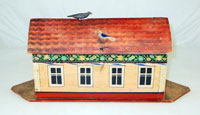
The Genesis flood story whereby Noah’s Ark plays a key role has always been popular with adults and children alike. So it’s not surprising that Noah’s Arks have been made as toys since at least the 1700s. During the mid-late nineteenth century, Noah’s Arks became one of the most popular wooden toys in both Europe and America. During the Victorian Era, every family of means had one. Since the subject of the toy was biblical, most children were only allowed to carefully play with their Noah’s Ark only on Sundays. This had the unintended consequence of helping to preserve the toys which is likely why we can find Noah’s Arks with animals in good condition.
Arks made from straw and individual sticks of wood were referred to as “prisoner arks” to imply they were made by prisoners using bedding straw – which some may well have been. The earlier, best arks were ones with boat bottoms (deep hulls) with separately carved animals and brightly colored surfaces. They might be stenciled but the frieze under the roof would be hand-painted and very original in design. Early arks had removable roofs to store the animals and people inside. Hinges were added later to keep the roof from separating from the ark bottom. In early arks, a painted bird with an olive branch was almost always included. Starting in the 1880s, you find arks begin to include lithographs to speed the production and reduce the time it took for hand painting. The later mass-produced arks were all lithographed and in this time period also became more predominately flat-bottomed.
 The arks were so popular that you had salesmen with elaborate toy books with hand painted pictures (ie catalogs) that would have example arks which customers would order. These toy catalogs are themselves rare and valuable collectibles. In the US, Wanamakers in Philadelphia and FAO Schwarz specialized in selling arks. In the mid-1800s the choices were limited to a few sizes and either deep or flat bottom design. By World War 1, the choices expanded to include not only many sizes and styles but also different animal assortments. In fact, animals were often sold separately as a 1893 catalog offers choices of different size animals of all kinds (real and imaginary) as well as people.
Since it was largely a cottage industry, it is impossible to identify ark manufactures. It is also hard to determine what the full complement of animals might have been for a given set; especially since the animals might have been ordered separately.
Just in time for the holidays - search for Noah’s Ark or other toys and more on Dig Antiques.
References:
German Noah’s Arks, Antiques Council, April 14, 2009.
Noah’s Arks, All About Old Toys, Jim Sneed.
Noah’s Arks, Old Antique Toys, May 29, 2013.
Noah’s Ark, Wikipedia.
If you are interested in opening your own Shop, it starts at only $149 for the year - no commissions.
Learn more and open your own Shop here.
Search on Dig Antiques
For yourself, or to help your young collector learn more, use Dig Antiques to search for your favorite antiques!