Utopia on the Prairie—Olof Krans Folk Paintings; Utopia Travels
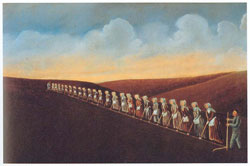
Utopia on the Prairie–Olof Krans Folk Painting
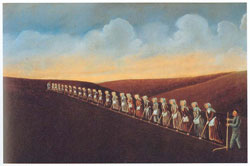 Bishop Hill Colony was founded in 1846 by a group of 1,000 immigrants under the leadership of Erik Jansson that fled Sweden for religious freedom. On the Illinois prairie, the “Janssonists” formed a utopian communal society which thrived. Although the communal experiment only lasted sixteen years, the economic and historical impact on the area was significant.
Portion of Olof Krans' Stage Curtain
Painted 1895, depicting Bishop Hill in 1855
Small sample of portraits painted by Olof Krans
starting in 1895, depicting members
of the Bishop Hill Colony
Olof Krans Self-Portrait
Search for folk art paintings on Dig Antiques.
References:
- A Prairie Dream Recaptured, David G. Lowe, American Heritage Magazine, October 1969.
- Digital Photography of Olof Krans Paintings, Why are they called Teddy Bears?.
- Krans, Olof, Encyclopedia of American Folk Art, Google books.
- Olof Krans, Wikipedia.
-
Bishop Hill, (video), Illinois Historic Preservation Agency.
-
A Prairie Dream Recaptured, David G. Lowe, American Heritage Magazine, October 1969.
- Digital Photography of Olof Krans Paintings, Why are they called Teddy Bears?.
- Krans, Olof, Encyclopedia of American Folk Art, Google books.
- Olof Krans, Wikipedia.
- Bishop Hill, (video), Illinois Historic Preservation Agency.
Utopia Travels
This year on our trip back to California from New York we decided to stop in Bishop Hill, IL. We had heard about Bishop Hill from antique dealer friends that have exhibited in its annual summer antiques show. Alas, we wouldn't be able to attend the show but we could spend an afternoon touring the old buildings and learning about this "Utopia on the Prairie".
Located about 20 miles off of I-80 and 160 miles west of Chicago, it was an ideal place to stop and break up our trip. With a perfect fall afternoon, we toured the open buildings and museums and learned about the first real wave of Swedes to immigrate to the US. We stayed overnight in a local inn and had an enjoyable time. The highlight of our short stay was viewing Olof Krans' paintings at the Bishop Hill Museum. With approximately one hundred of his paintings and the original stage curtain, we had our fill of eye candy!
To top off our visit at the museum, our docent was a descendent of the Bishop Hill colonists and grew up in Bishop Hill. She indicated that not everyone was all that happy with Olof's portraits as there were some that did not think the portrait was too kind to themselves or their relatives. She swore that today she can see spitting images of at least two of the portrait descendants. Aah, genetics are a wonderful thing! The other story she shared with us was the improbability that these portraits actually survived. When she was a child, the portraits were stacked along the walls of the old Colony Church. She and her friends would play school with them, sitting them on chairs and pews as if they were their pupils. It would have been a shame if these wonderful folk art paintings hadn't survived. Thankfully, beginning in the early 1960s, the idea took hold that the buildings and paintings needed to be preserved for future generations.
We hope you are enjoying our newsletter. If you have a chance, please visit the Shops on Dig Antiques and don't forget to take advantage of our search engine as you are looking for antiques.You can have your own shop for only $149/year. Learn more here.
Sincerely,
Tom & Sheila Baker
diginfo@digantiques.com
We Dig It...do you? Dig Antiques - Real stuff without the fluff.