Welcome to Forget-Me-Not Antiques. I have been actively involved with antiques for more than 45 years and a licensed dealer since 1985. When I retired in 2008 my wife and I moved from VT to MI to be closer to family. We live in a Victorian home where I also have my antiques shop. We offer primarily Americana, in natural surface and original or early paint, from the late 17th to the late 19th century. Our items include treen, early lighting, hearth iron, pewter, small pieces of furniture, pottery, stoneware and folk art. I also have a Facebook page, Forget-Me-Not Antiques, where I feature selected items.
I accept personal checks, money orders, major credit cards, Venmo, and PayPal ronaldmyers@gmail.com or forgetmenotantiques@gmail.com for PayPal payments. A surcharge of 3.9% may be added to cover fees.
I offer layaway to help with your purchases. Please inquire about layaway plans.PLEASE NOTE: Items on layaway are not refundable, exchange only. MI residents add 6% sales tax.
All items are guaranteed as described. I will happily accept the return of any item within 3 days of receipt for a full refund less return shipping and insurance unless I have unintentionally misrepresented the item, in which case I will pay return shipping. Please notify me of your intention to return an item.
USPS or FedEx shipping preferred.
I will update my offerings often so please check back frequently. LAYAWAY AVAILABLE, INQUIRE. PLEASE NOTE: Layaway items are not refundable, exchange only. Thank you for shopping. Ron
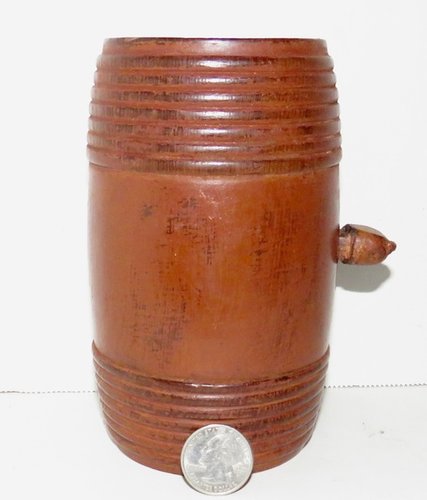
Just a wonderful Rev. War period rundlet with the best original very dry New England red paint and stopper. Super turnings with 7 pronounced rings top and bottom and concentric circles on both ends. Measures 5” x 3 1/2” at center. No issues. Great color. Not often found this nice.
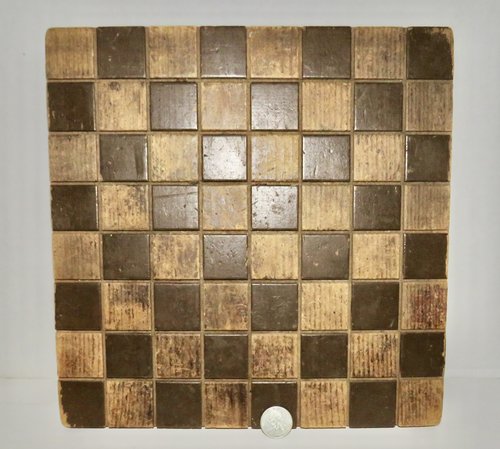
Very nice small checkerboard with deeply outlined and painted squares. Original Spanish brown paint and unpainted 1 3/8” squares. The board measures 11 1/2” x 11 3/4” x 3/4” thick. Early 19th century. Small checkerboards like this were commonly used in taverns and inns of the period for patrons to use while enjoying an ale.
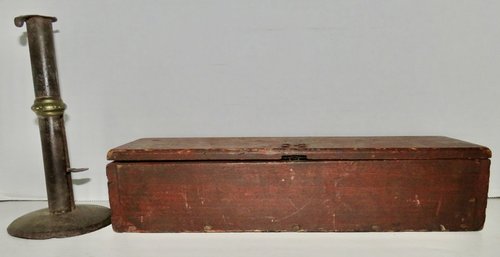
Courting candlestick, chair hook, candle lifter is a round tab with a hole and works fine, ash base, peened through base, 7 3/8” tall with a 3 7/8” diameter ash base, marked LM-LN, English or American, mid-18th century.
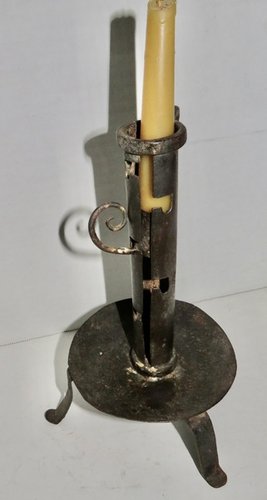
Pilgrim era forged iron candleholder; adjustable candle height; penny feet; curled handle on lifter; clover shaped wing nut under base; 9 1/4” tall with a 5” wax catcher; carrying handle/chair hook. There is a tiny 1/4" break in the wax catcher pan and one leg is fastened with rivets that appear to be how it was made. C. 1680-1720. Scarce.
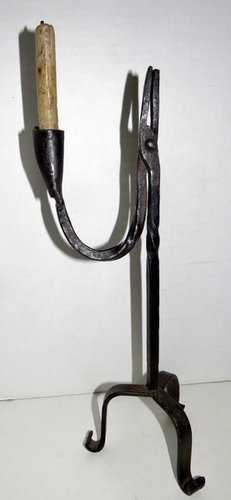
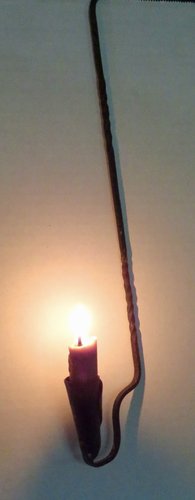
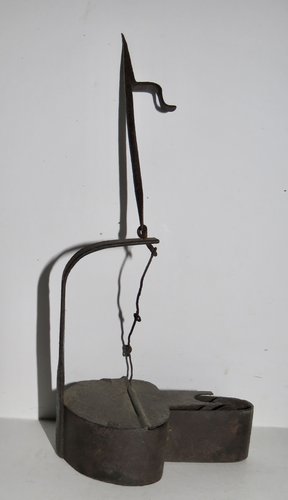
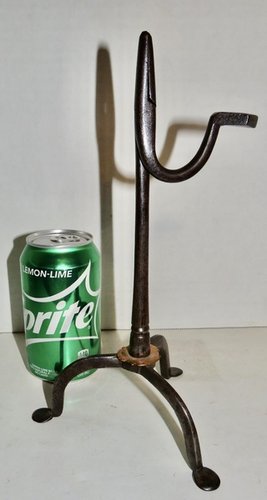
Pilgrim era rush light with candle socket and twisted counterbalance arm. Later black paint over original black paint. 14 7/8” tall. Folded candle socket formed from arm. Curled ends on legs. Rare to find this early. C. 1720-1750.
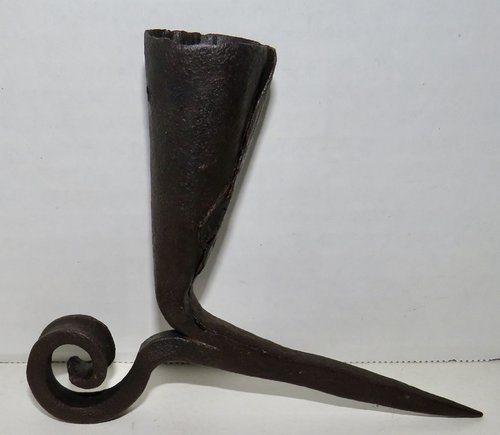
Early 18th century hand forged iron beam spike candleholder. 4 3/4” across the spike x 4 1/2” tall x 1 1/4” candle folded socket. Clean out hole and curl on end of spike.
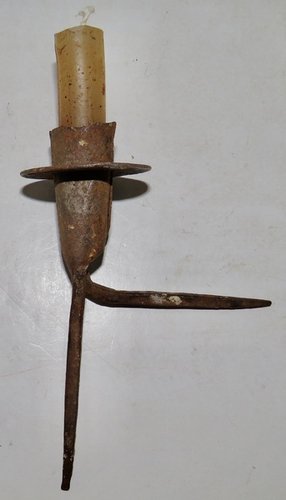
I am offering a seldom seen double wall spike candle holder. Folded candle socket. Spikes are about 3 1/4” long and overall length to top of candle holder is 5 3/4”. Forged ring wax catcher. All original. Minor surface rust. Early 18th century. I have only owned a couple of these double spike candleholders.
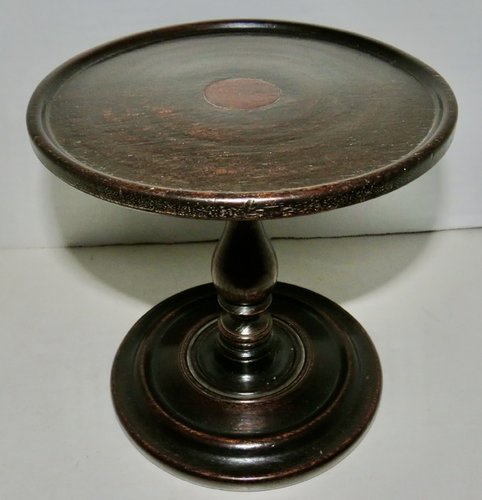
High country ighting stand or tidy for a candleholder. It is 7” tall x 6 7/8” dia. top and 6” dia. base. The wood is walnut with the original stained shellac or varnish. It is American and dates mid to late 18th century. No issues. What appears to be a crack on the bottom is a flaw in the wood and does not show on the top.
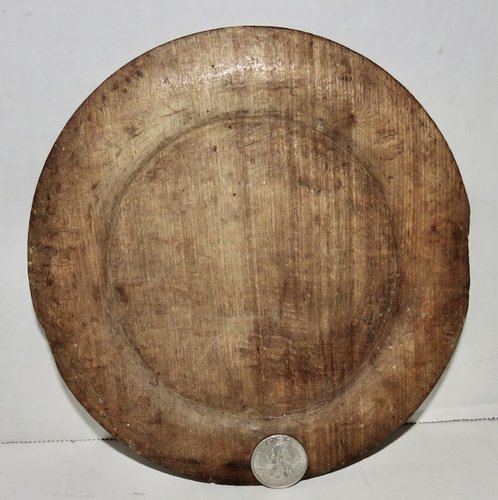
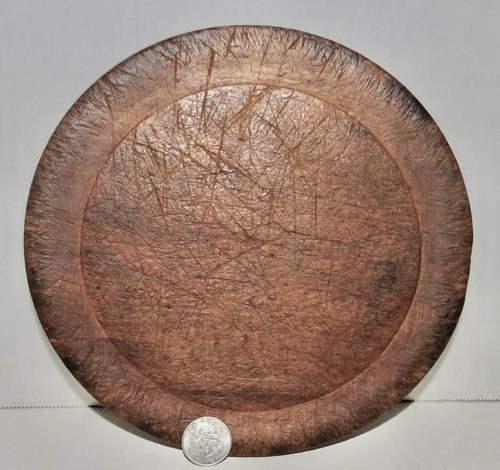
American 18th century maple eating dish with owner’s initials, C. L., on back. Pole lathe turned with raised foot. 7” x 1/2” tall with good shrinkage. Minor rough edge wear. Good surface wear from use. Northern VA collection.
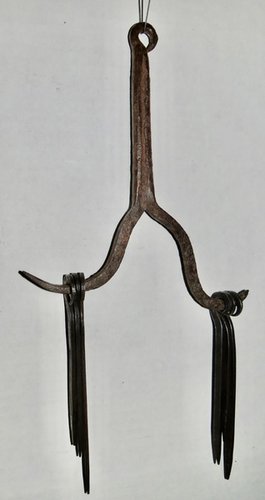
Very early hand forged iron skewer rack with 6 skewers. Unusual form being hand forged from one piece of iron. 8 1/2” tall 7” across the holders. Hanger loop on top end and the skewer holders are unevenly forged. Hand forged skewers have super nice curls. There are 2 @ 6 1/2”, 2 @ 5 1/2”, and 2 @ 4 3/4” long. Dating early to mid-18th century, c. 1700-1740.
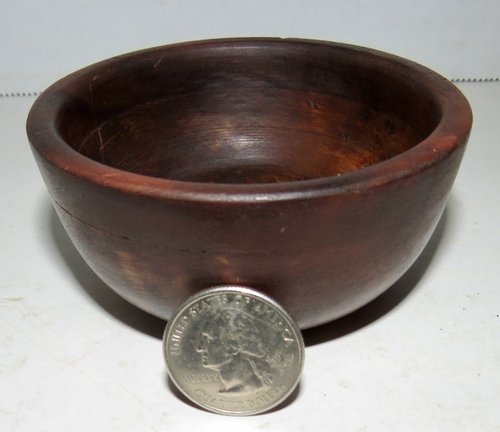
American 18th c. bird’s eye maple miniature bowl or a table spice bowl. Bird’s eye maple is only found in the northern states along the Canadian border. It is unusual in that the bowl consists of 2 pieces of maple, a 3/8” top and the bird’s eye bottom. Pole lathe turned with a well defined foot. It still retains much of its original very dry red paint. 3 1/4” x 1 1/2” tall. No issues.
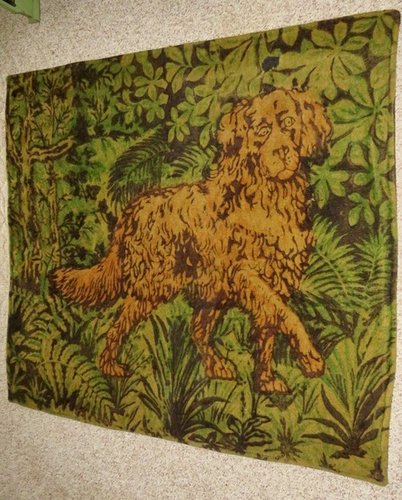
Just in time for the winter season, this wool horse drawn sleigh or buggy lap blanket will keep you toasty warm. It has a wonderful hunting dog in a forest scene on the top and a black wool piece on the back. This blanket dates to late 19th or early 20th century. It is in good condition with just an old repair to a hole, second photo, and a small area of wear that was stitched. The blanket is 56” x 52”.
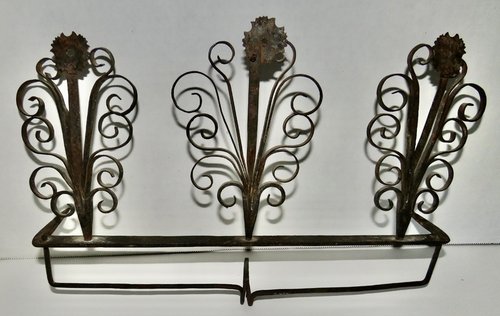
Rare 18th c. forged iron lighting or utensil rack, would have driven spikes into wall, the curl on center of bar holds the rack away from the wall to hang items, 13” wide x 8 3/4” tall, wonderful iron work, decorative pieces wiggle slightly but are secure and stand upright as they should.
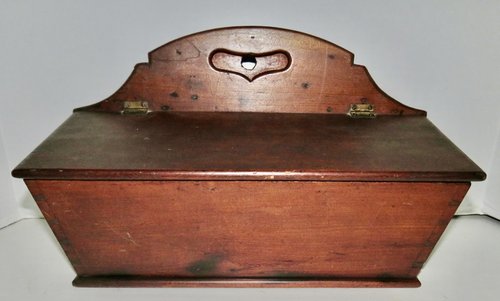
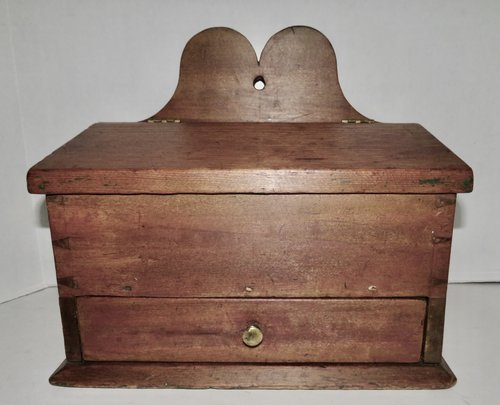
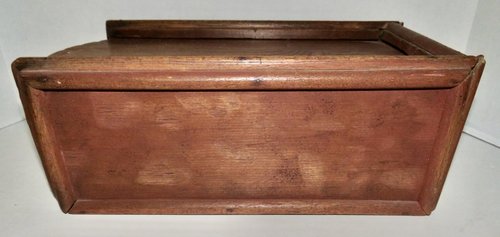
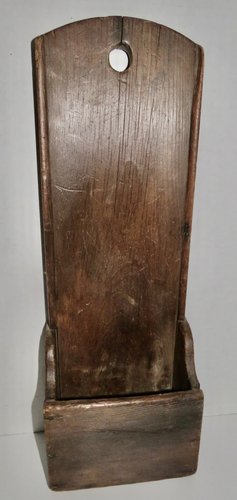
American 18th century, c.1780’s, cherry wood wall candle box, possible CT origin. Canted sides, brass hinges with iron screws. Dovetailed construction with tiny T-head nails. Rare and wonderful original heart hanger cut out around hanger hole. A small piece of wood apparently split out on the top left of the back and the original piece was put back with a nail to hold it. Barely noticeable. Wonderful dark patina on untouched dry natural surface. 15 1/4” x 6” deep by 9” at back. More photos available.
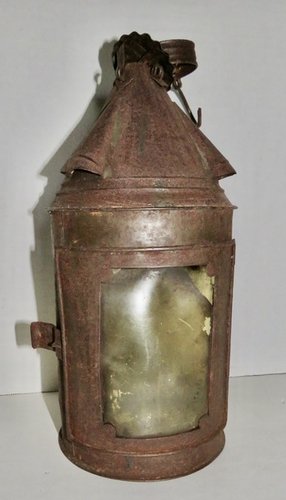
Lanthorn or horn and tin lantern having 3 shaved horn windows and a strap tin ring for hanging or carrying. There are 3 hooded ventilators to furnish necessary draft and an external holder for a pole for parade use. The windows have missing horn but approximately 90% is solid. 16 1/2” hanging height x 5 1/2” diameter. The tin pieces below the smoke bell have broken off but that doesn’t affect the handle. Ca. 1750-1820. Rare.
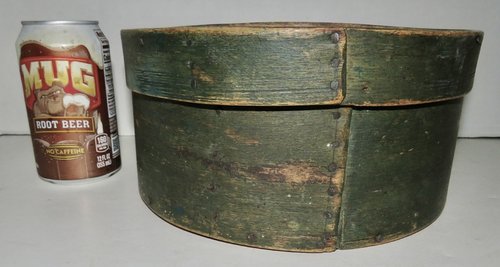
Early 19th century, ca.1840, thick walled pantry box with original forest green paint and wooden pegs and hand cut very early nails. Great surface and no issues. 9 3/4” x 4 3/4” tall.
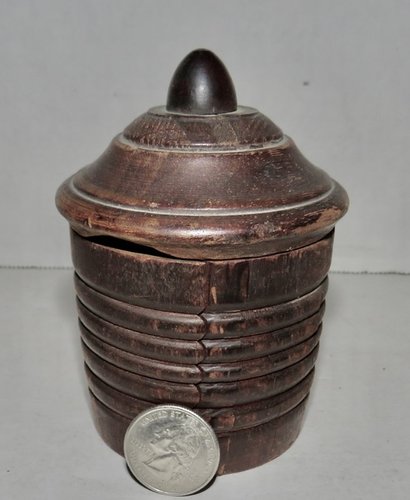
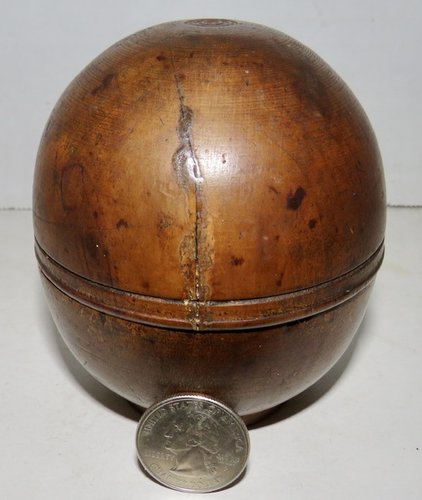
Very early 17th early 18th century pole lathe turned beehive shape lidded table jar for spices or herbs. Wonderful untouched surface patina. Acorn finial was carved separately. Few minor well worn chips and a tight hairline on top that doesn’t go through. A very tight crack on jar side that doesn’t go to the inside. 4” tall x 2 1/2” dia. Super form and surface.
Pilgrim period, ca.1680-1740, gouged out porringer or cup. Super carved out and rasp shaped out of hard maple, it has the remains of the original black paint. Wonderful untouched surface with the best patina. There is a shrinkage crack in front of cup from normal age drying. There is an in the period hole that was drilled at base of crack to prevent further splitting, 7 3/4” long x 5 x 5 x 3” tall cup. They just don’t get much better. Could have been used as an eating bowl and/or drinking cup.
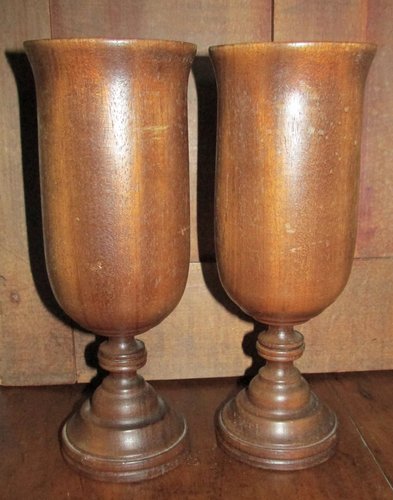
Seldom seen pair of 18th to early 19th century, ca.1780 - 1820, large treen drinking cups or chalices. These would have been used for wine or ale in taverns or pubs or public houses. Pole lathe turned from walnut wood. Measurements are 9 1/2 tall x 3 1/2” top diameter. Excellent condition with no issues. Untouched natural surface. rare to find pair.
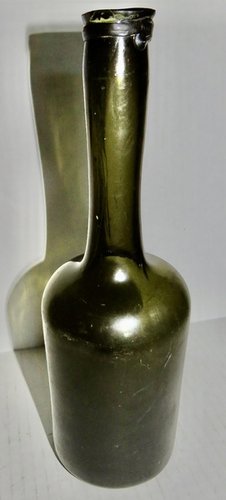
Super early 18th century black glass long neck tavern bottle having nice rounded shoulders. Great string lip. There are numerous striations in the neck with air bubbles. Good sheen and surface. Normal wear from use. 11” tall x 3 1/4” diameter. 5 1/4” neck from the shoulder and the base is 5 3/4”. Out of round base with a raised sharp pontil. No issues.
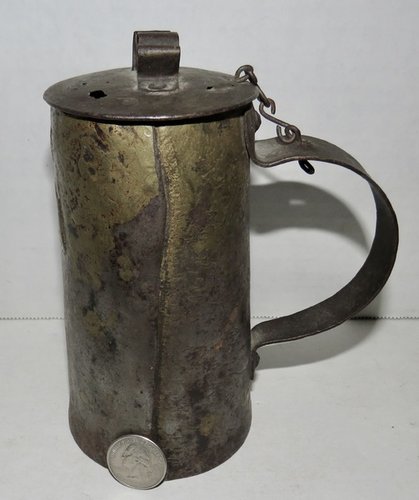
Very rare ca.1680-1720 forged iron tavern ale warmer with attached original lid. 5 1/2” to lid x 3 1/4” diameter base. Minor rust holes in lid but nowhere else. It appears to have a brass wash on the surface. This is the only forged iron ale warmer I have ever seen.
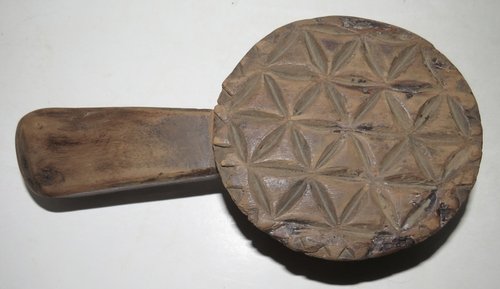
Rare chip carved lollipop form, 18th century, ca.1750, walnut PA butter print. The reverse side has a design scribed onto it but was never chip carved. 7 3/4” with a 4” x 4 1/4” diameter top side and 3” diameter bottom side and 1 1/2" thick. Untouched very dry smooth surface with super wear from use.
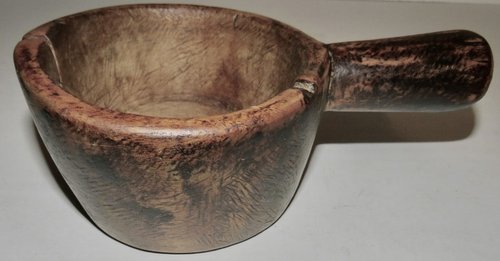
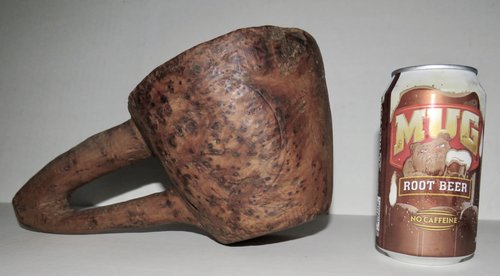
One of the best Abenaki Atlantic white cedar burl handled bowls I have owned. Ca. 1800 - 1820. Measures 10 1/2” o/a length x 5 3/4” dia. x 5” high. The bowl tapers down from the rim. It is hewn from white cedar burl. Rhythmic gouge marks are evident on the interior and remains of rasp marks are seen on the interior and exterior. Not often seen double concentric ring design is repeated 3x around the bowl and one double ring design is on the bottom. There is no design inside the rings. Very good condition with just a very tight hairline in the front that doesn’t allow light to pass through.
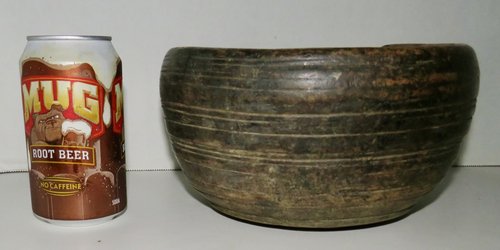
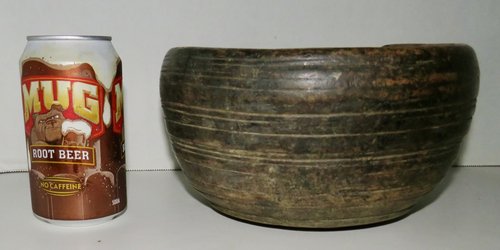
Pilgrim period, 17th century, very rare and hard to find well turned walnut deep eating or serving bowl. Suggests PA in origin. Retains good remains of original Spanish brown paint. Footed and measures 8 1/2” x 4 1/2” tall. The best untouched very dry and well worn surface. The foot shows it was sitting on a damp surface and has minor losses but is very hard and firm. Came out of a very old and good collection. More photos available.
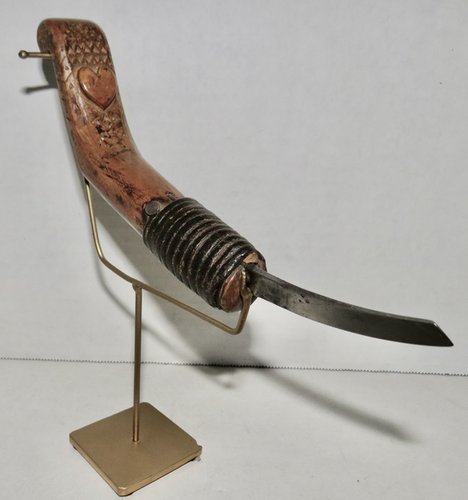
Native American, Iroquois, crooked knife. Colonial house or church carved on one side and a wonderful heart carved on the other side. Chip carving down the sides. Maple with steel blade. Unusual leather wrapping. 8 3/8” o/a, 2 3/4” blade. Ca. 1780’s.
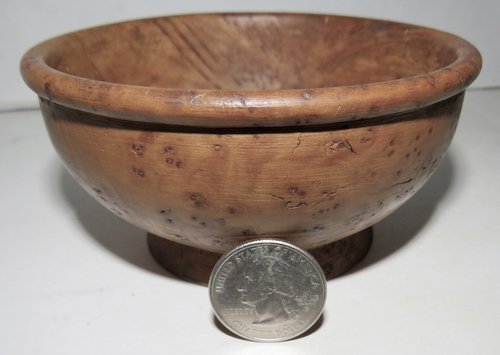
Rare miniature hand carved ash burl bowl. 4 1/8” x 2” tall with a 3/16” rim and a 3/8” foot. Super untouched dry surface with good eyes and grain patterns. What looks like a small repair on the foot rim is a flaw in the wood. In the making dark fill on the outside of the bowl. Good wear on base. 18th to early 19th century. Rare.
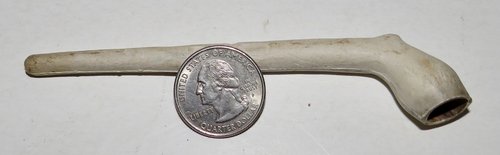
Very rare complete clay pipe bowl and stem found at Jamestown, VA. Measures 4 1/2”. First period pipes are very hard to find. Ca. 1650. No issues. Only the 3rd one of these early pipes I have owned. Reference: "Early American Antique Country Furnishings" by G. Neumann, p. 328.
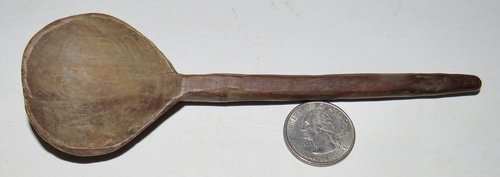
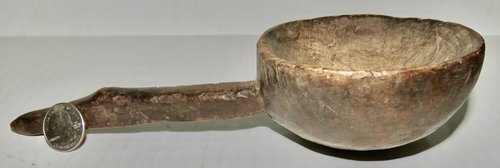
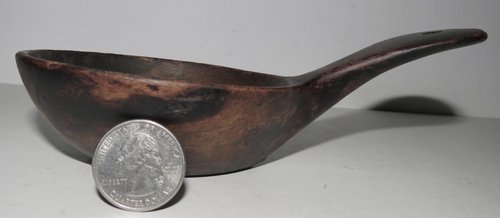
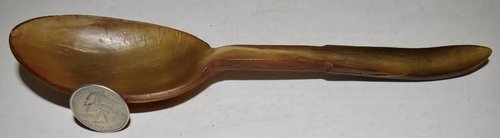
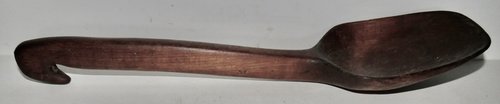
Pilgrim era, 17th - early 18th century hand carved wooden spoon. Fig shaped bowl that is typical of 17th century spoons. Two minor tight cracks in the bowl. Great surface patina and wear. 6” long.
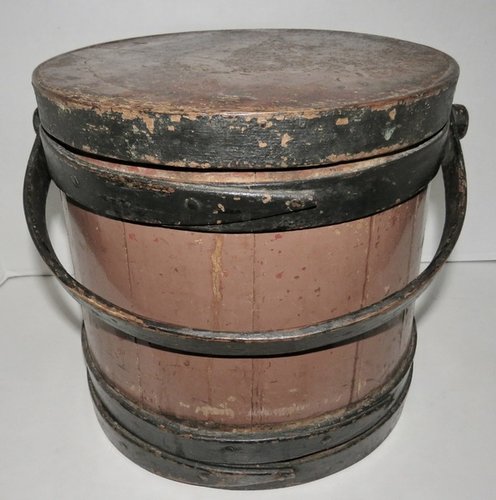
Early firkins having salmon color paint just don't show up very often today. This firkin, having early salmon milk paint over the original red on the staves and black painted bands is just outstanding. There are small button pegs on handle with hand carved wooden pegs on the inside to hold them in place. The firkin has a 10 3/4” top diameter and a 11 1/2” bottom diameter and is 11” tall with the handle down. Ca. 1840-1880. No issues, just normal wear from use. It is very clean inside with no off odors.
Wonderful, museum quality, late 17th century Pilgrim period one-piece American burl maple hand hewn and carved porringer with a handle. Original untouched natural attic surface and patina. Ca. 1670-1700. Would have been used as an eating bowl, mortar, or cup. Unusual crooked handle suggests Native American. Super condition with just one old and very tight surface or stress line in the bowl that is not a crack and it does not go through. 9” long and the bowl is 3 3/4” diameter x 2” deep. Came out of an old CT collection. The shine in some of the photos is from the flash. Very dry natural surface.
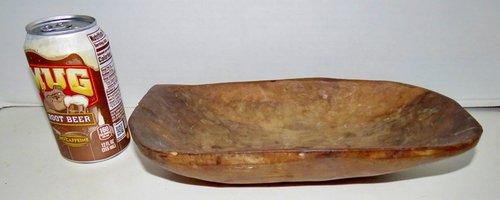
17th or early 18th century hand carved small maple trencher that is most likely Native American. Super untouched very dry surface. 10 3/4” x 5 3/4” x 2 1/4-2 1/2” tall. Tight shrinkage cracks on both ends. Rare. More photos available.
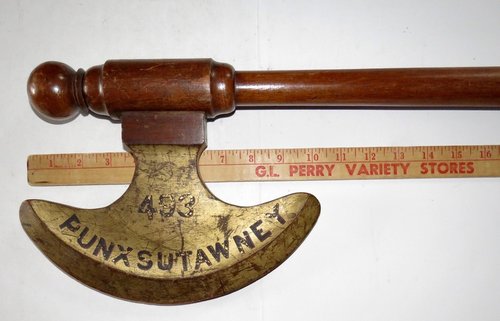
PUNXSUTAWNEY 493 in black paint on original gold paint wooden axe. Possibly a fraternal organization in Punxsutawney, PA. 40 1/2” o/a length with a 10 1/4” wide x 8 1/4” tall axe head. Round handled tapered toward either end. Gold paint on both sides of axe head but lettering only on one side. Late 19th century. No issues. Rare find. Would look great displayed on a wall.
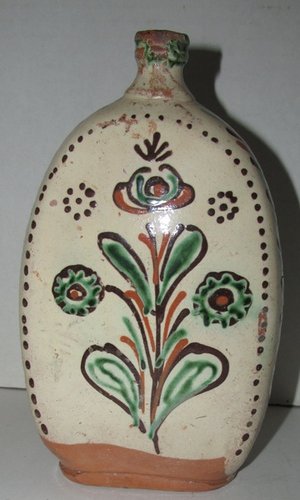
A not too often seen but very good redware Sgraffito flask, probably French. It is in very good condition with minor roughness around neck from use. There is very fine glaze crackling and wear marks. The glaze colors are tan, brown, green and white. This flask dates to early 19th century, c.1820-1840. Size is: 7 5/8”T x 4 1/2”W x 1 3/4” thick. Looks great displayed on a shelf. Not too commonly found.
A very good, honest early 18th century hand forged iron loom light. Twisted square stem with hook for hanging. Great vertical folded candle cup. 15” hanging height. Candle cup has a 7/8” diameter opening and is 2 1/2” long.
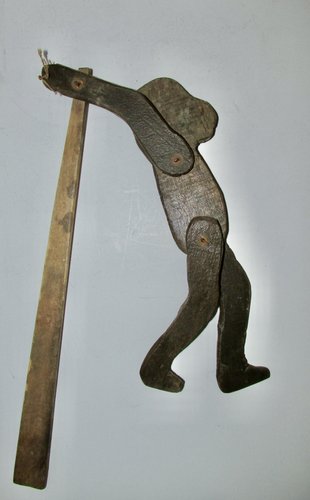
Just a wonderful jointed jigger dancer wooden monkey child's toy with remains of original paint. 11” tall and stick is 12 1/8” long. I can just imagine a child playing with this jigger monkey toy, making him hop and jump by using the stick to make it move. This jigger has good honest wear from many years of use and all joints work freely as they should. No issues and rare to find this nice. 19th century.
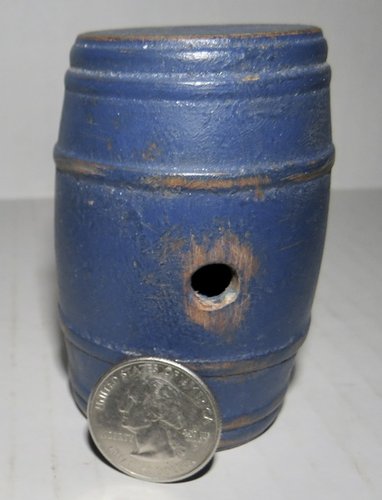
Very rare miniature Rev. War period rundlet with original blue milk paint. Lathe turned having 6 rings. Wonderful wear from use. Measures just 3” tall x 2” diameter. Would have been used for rum and carried in a haversack or hunting bag. Rare to find this small and with paint.
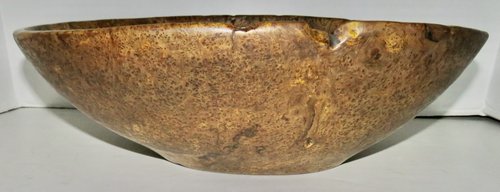
One of the best 18th century oblong Iroquois ash burl bowl you will find! Wonderful figural grain with the best eyes covering most of the surface. Very smooth surface, well worn with a couple natural indentations in the rim. No cracks, repairs, or damage. Numerous knife marks inside from chopping. 15 1/2” x 11 1/2” x 4 1/2 - 5” tall. Rare to find this nice. If you have been wanting an outstanding burl bowl, this one is it!
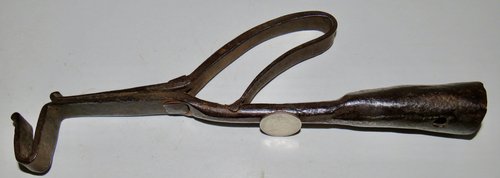
One of the best pole mounted rush/splint holders I have found. Heavy forged iron with super nice patina. Dates 17th to early 18th century. 10 1/2” o/a length. Similar example can be seen in “Early Lighting” by the Rushlight Club. Easily mounted on a pole for display.
Rare 18th century, ca. 1760-1780 doubters. 4” long x 2” across handles. Star design on top of the rivet. These were used to snuff the flame on a candle. Quite rare and a must have to go with early lighting.
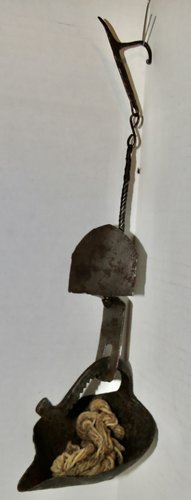
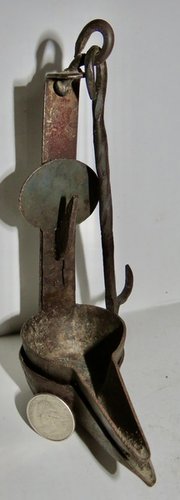
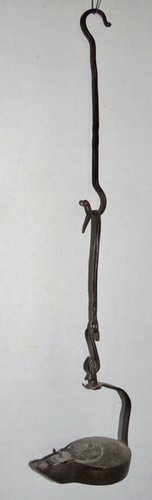
A not often seen Pilgrim era, 17th to early 18th century, iron canting Crusie lamp. A simple wick channel lamp w/o internal wick support. Swivel suspension plus a ratchet arrangement to permit a canting action to keep the wick in the fluid. Great forging with nice twists and pigtail curl on hanging halbert hook. 13 3/4” hanging height. 3 7/8” x 4 3/4”x 1 1/4” deep pan. English. A nearly identical one can be seen in “Early Lighting” by The Rushlight Club page 37.
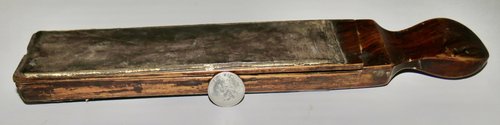
Very nice, ca. 1830, New England grain painted razor box and razor. Leather on top and bottom of box with velvet inside. Wonderfully shaped lollipop handle with carved scroll on both sides. Measurements are 12 1/2” x 2” x 7/8” deep. Razor is 6 1/2” long. Normal expected wear, no issues.
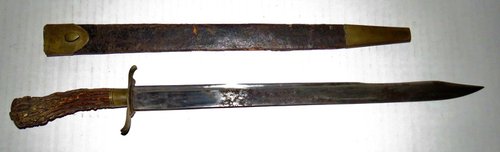
A very desirable Scottish hunting sword or belt dagger with rare to find original scabbard. Blade is grooved, 14 1/4” long, and double edged for 5 1/4” from tip. 19” o/a length. Antler handle with brass end plate. Brass ferrel with a leather piece for scabbard to butt against. C.1740-1780. Scabbard is leather covered wood with a small, thin 4 1/2” section of wood on top of scabbard missing (see last photo). Also wear from use on both sides. More photos available.
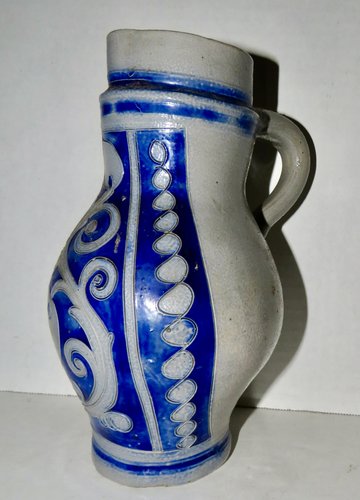
Westerwald tavern stoneware pitcher, ca.1780-1820. Made in Germany and brought to Britain and the colonies. Very good condition having nice patina. No chips or cracks. A factory made hole is on top of handle for attaching a lid which this one never had. Would have been used in taverns and inns of the period. Similar pitcher can be seen in George Neumann’s, Early American Antique Country Furnishings, p. 263. 9 14” x 6” wide ovoid center with handle. 3 1/8” dia. base.
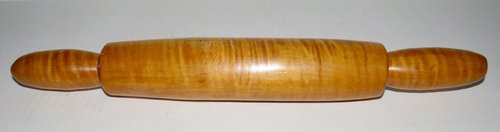
Tiger maple rolling pin. One piece construction. Very strong tiger stripes that form ripples on the surface. 18” long x 2 1/8” diameter. 18th or early 19th century. No issues.
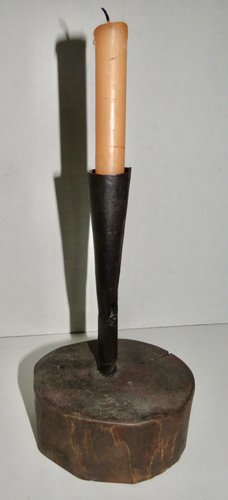
Early to mid-18th century forged iron candle holder with wooden base. Folded candle cup. Untouched natural surface. Wood base has a small shrinkage crack. 8 3/4” tall with a 5 1/4” - 4 1/2” oval x 2 1/4” tall base. Rare form.
American wooden lighting trammel, 17th early 18th c., maple and pine woods, wooden pegs, wonderful wear and untouched patina. Remains of original reddish brown paint. 28” minimum and 44” fully extended, period repair to hanger end where it wore through from use. Very rare, museum quality. These are very seldom found. I have only owned 2 in the past 20 plus years.
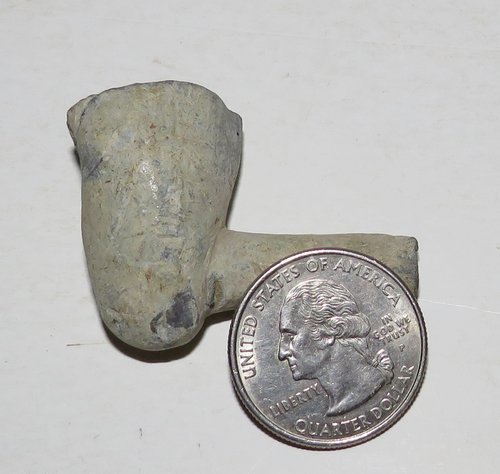
Very rare 17th century dug lead pipe bowl. Ca. 1600-1650. Possibly American Indian fur trade pipe. Only the second one I have owned. They are not often seen and display wonderfully in a tavern scene.
Very early, ca. 1700-1725, southern pine candle box with dovetails and T-head nail construction on the bottom. The deeply chamfered lid has a wooden peg to hold the lid tight and a wooden peg in the opposite end to hold the lid tight. Minor wood loss to edges of lid but doesn’t affect holding in place. Great dry surface. Measures 12” x 6 1/2” x 5 1/2” tall. More photos available.
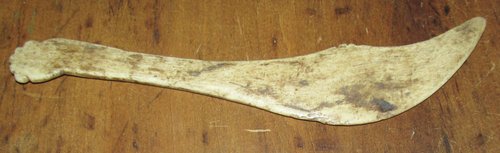
Unusual sailor made whale bone fish scaler or hide scraper. Could have been used for either purpose. 7 1/2” long and 1 3/4” at widest point. Great color and condition. 18th or early 19th century. If you like the rare and unusual items, this piece is a must have.
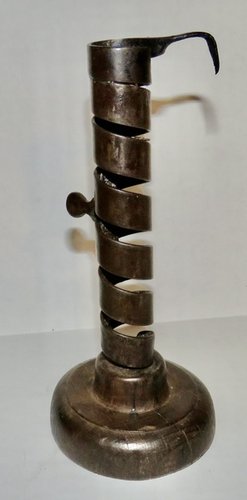
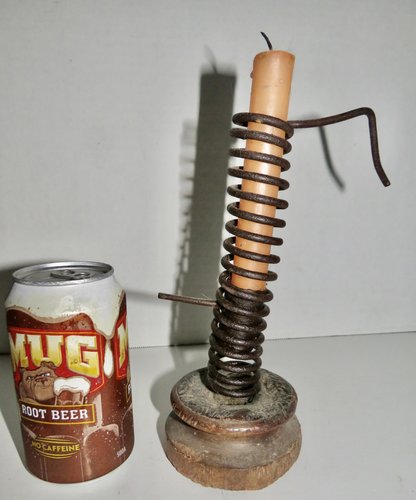
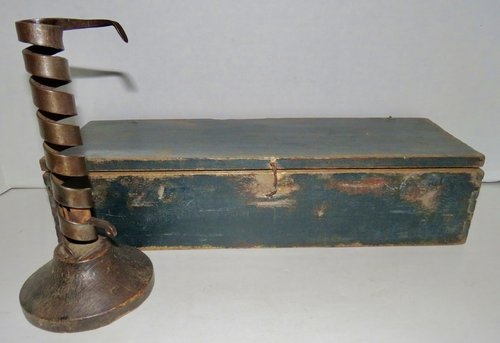
17th to early 18th century spiral candle holder with a wooden base. Spiral is peened over on base. Untouched natural surface. 8” tall with a 3 1/2” x 1 3/4” base.
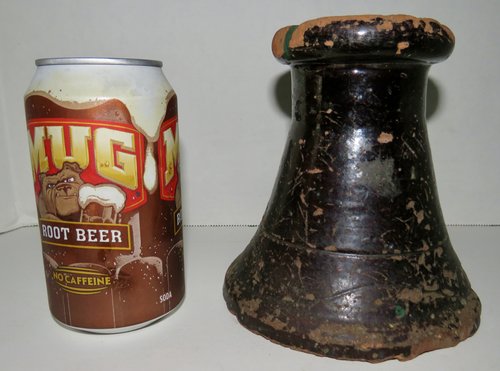
Authentic redware, ca.1750-1800, grease lamp tidy with original black glaze. It has 2 incised circular lines plus an incised wavy line below the bottom line. Glaze wear on the top and around the base. Well worn chips on the top and bottom edges with a 1 1/4” x 1” flat chip near base. Measures 5 1/2” tall with a 3 3/8” top and 5 1/2” base diameter. Tidy is hollow. Very rare. A real redware tidy and not the shorter stove stands that are often offered as a tidy.
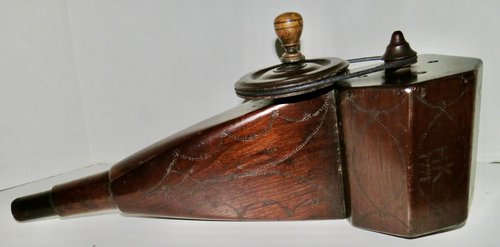
I don't often use the term "museum quality" but this fireplace bellows is just that in my opinion. It has punched designs on all front sides with a 1771 date. Hand crank pulley driven with flat tin bellows inside. Black walnut wood with a shellac and/or waxed surface. Probably of PA origin. It measures 19 3/4” tall x 5 3/8” at top. Minor nail split at top side and the pulley belt was replaced. American and probably PA origin. Very rare. Only one of this style that I have owned or seen. It was hard to get good photos of the surface. It looks much better in hand.
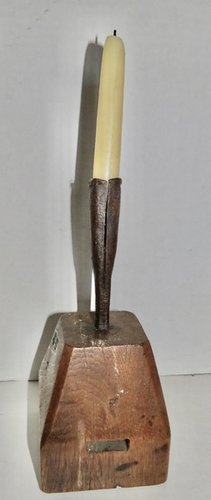
This wooden candle holder has a definite nautical feel to it. It may be a make-do candle holder or intentionally made in that style. I am dating it to the 1650-1720 period. It is American and from coastal New England. The best candle spike with bayonet type rolled edge socket and clean-out hole. The wooden base has 4 hand cut slots that go through. Their function is unknown and may purely be representative of something of the sea as it has the appearance of a marker buoy. 10 1/2” tall with a 4 3/8” x 5” tall base. Early forged nails secure stable cracks. Untouched natural surface with a great patina.
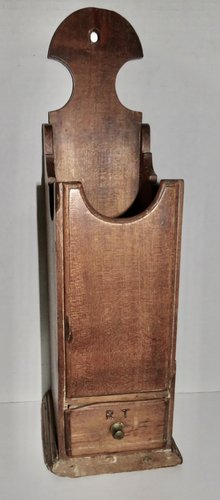
American, Queen Anne period, New England, maple pipe box. Ca. 1700 - 1750. Wonderful surface patina that only early maple attains. Dovetailed base and drawer with T-head nail construction. Original brass pull on drawer. Molded base strips. The front molding is an early period replacement as is a small piece of wood on the back bottom of the drawer. There is also a period crack across the bottom of the drawer front. Early tight wood splint on right side of box from a break. Shallow chip out of the top that is well worn. Original initials “R T” carved into the front of the drawer. Super scalloped sides and whale tale end on back board. Some white paint drips and smears on back and bottom and inside compartment that don’t show from the outside. Measurements are 18 3/4” tall x 4 1/2” wide x 5” deep. Very high end pipe box with good honest wear. More photos available.
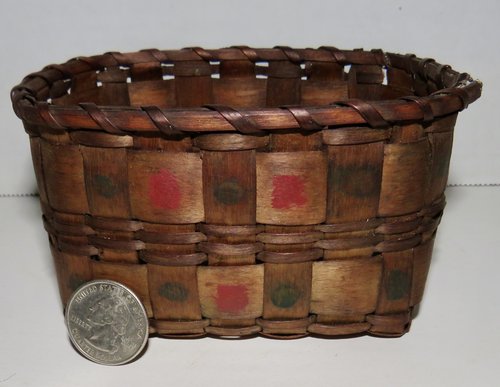
Very small, miniature, basket having original potato stamp design in red and green paint. Northeast Native American. Only 4 5/8” x 3 5/8” wide x 2 5/8” tall. No issues. Rare small size.
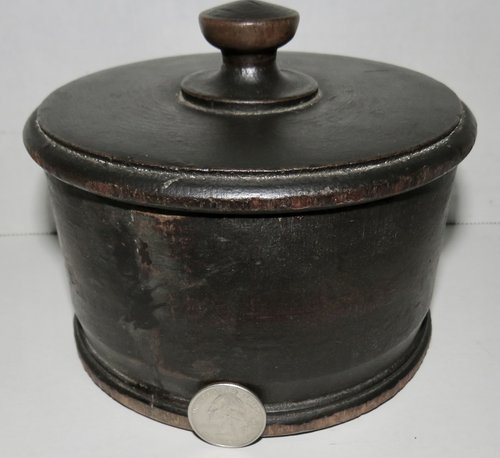
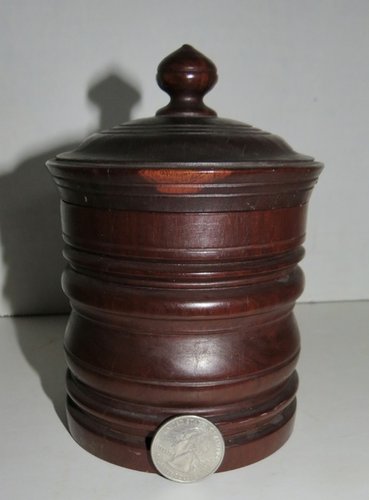
Not ofter seen 18th century lidded tobacco jar with original dark Spanish brown paint. Ca.1780. 5 1/2” diameter x 4 1/2” top of knob. Very tight hairline crack down the side that goes through to the inside. There is also a short insect trail on the inside that was there when the jar was made. Rare to find this nice.
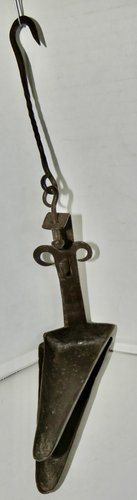
Very rare Pilgrim era, ca.1650-1700, hand forged iron double Crusie lamp with ram’s horn back and adjustable pan to keep wick in the fat. Twist in halbert hanger. 12 1/2” hanging height and 6” x 2 3/4” x 3/4” deep pans. Wonderful untouched surface and condition. Rare to find this early.
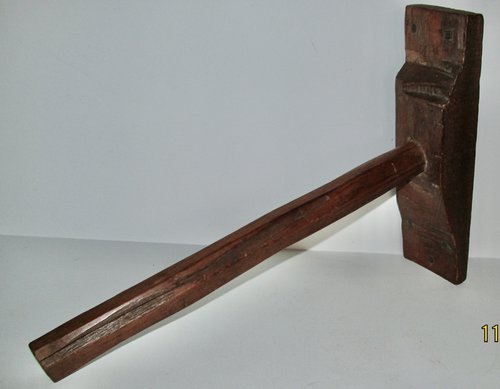
Wall peg, 18th century, for hanging coats, hats, etc. from. Untouched natural surface having the original square nails used to fasten it on a wall (cut off on back likely to remove it from a wall). Made of walnut or chestnut wood. 14 3/4” long with a 10 x 2 3/4 x 1” back board. Peg is mortised through.
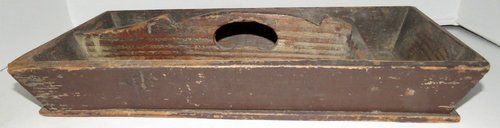
Offered is a quite scarse southern pine divided cutlery tote having original very dry Spanish brown paint. Hand cut nails. Ca. 1840’s. Canted sides. 15 1/2” x 8” x 2 1/4” sides. Wonderful wear with no issues.
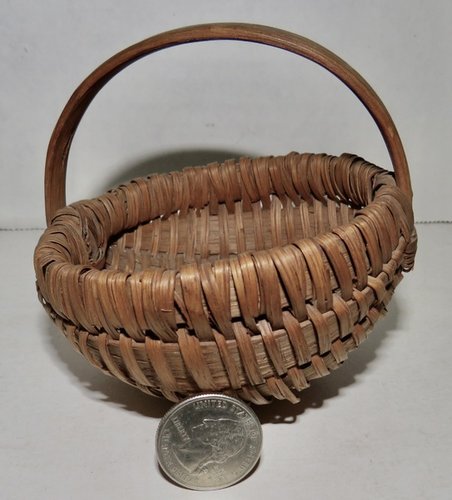
A late 19th Century PA split oak miniature oval egg shaped basket with great patina. This miniature basket is cute and small. The diameter is approximately 4” inches and it measures about 3” high. This is a great miniature basket in great condition. Fantastic example. No breaks or damage! This is early, all original and really nice with patina. Bought from a single owner in Pennsylvania. This is a great miniature size and is a fantastic early piece. Shows better in hand.
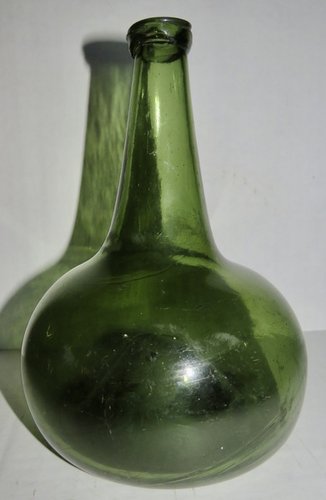
A once fairly common item to find, these have become very difficult to come by. Early black glass hand blown Dutch onion bottle; early 18th century c.1720; light olive green color; 7 1/2”tall x 5 1/4” diameter; deep sharp pontil; applied string lip; very minor hazing inside; no scratches; wavy glass; no issues; found off FL Keys; Rare to find this nice; a favorite bottle for rum in the period.
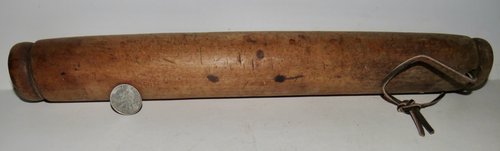
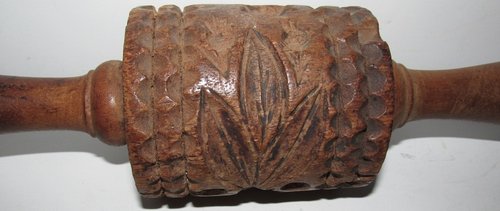
Butter or cookie roller print, maple, continuous roller, PA, 13 1/2” long with a 2 3/4” diameter x 3 1/8” wide roller, deep carvings of tulips, leaves, flowers, early to mid 19th century, rare and desirable. More photos available.
Early 18th century make -do candle lighting device. Maple wood base with untouched surface and initials “T N” carved into base. Forged seam on candle socket and a clean-cut hole. Minor tight shrinkage cracks. 6 1/4” tall with a 2 1/2” x 3 3/8” diameter base. VA collector.
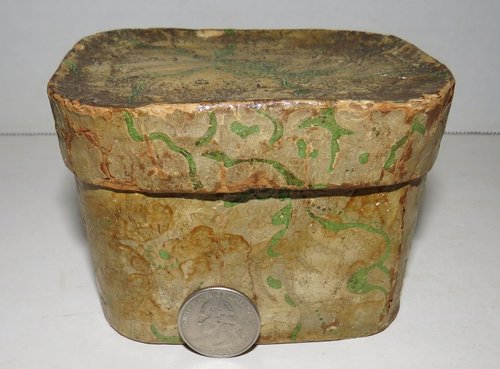
Very early miniature American wallpaper box. Measures just 4” x 3” x 2 3/4” tall. Lined with newsprint inside and on the bottom from Philadelphia and Boston and have an 1814 date. The wallpaper has an original coat of varnish or shellac to preserve the wallpaper. Rare to find a miniature this early.
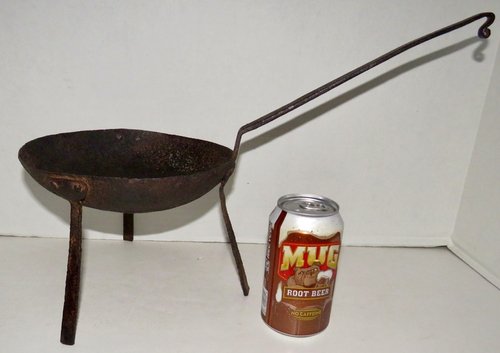
Rare 18th century, Rev. War era small size forged iron encampment cooking spider. Tall legs and a curl on handle. Measures 8” in diameter and 6” tall and a 9” handle. No issues. Rare to find this size.
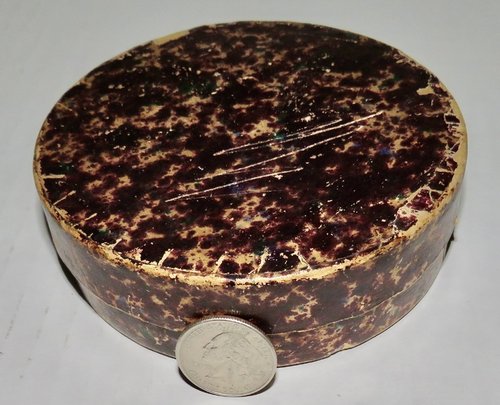
Miniature round wallpaper box. Sponged tortoise shell in brown and tan colors with tiny green and blue dots scattered throughout. Wallpaper is glued on and is not sewn. The lines near the edges are folds in the paper. Signed on the bottom “Property of Frank H. White”. About 4 1/2” x 1 1/4” tall. Expected minor wear from use but no damage. Ca. 1850 - 1870.
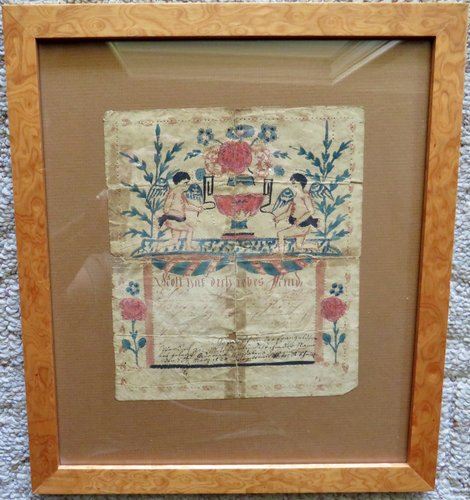
PA watercolor fraktur. Dated 1824. Outline is pin pricked. Professionally framed and mounted on acid free backing. Fraktur is 7” x 8” and figured maple frame is 12” x 14”.
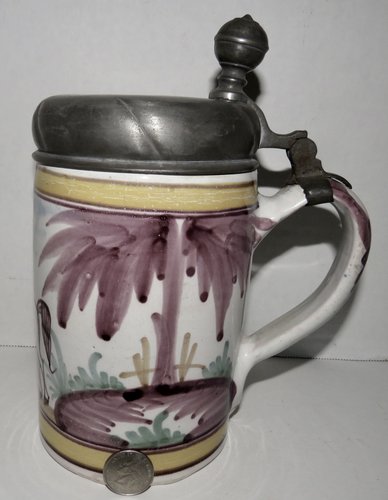
Rare Pilgrim era, ca.1680-1730, German tavern stein. Tin glaze with purplish brown colored trees and prancing horse and fence light and dark green colored plants with blue. Pewter handle and lid and thumb knob. Creased curved indents around lid. Hall marked inside lid HM with a flag. Linen mark inside lid where handle was applied. Great color with a horse. 8 3/4” top of knob x 4 1/4” diameter base. No issues.
Rare 18th century canoe cup. One of the best I have owned. Carved very thin from maple wood. Wonderfully shaped with a flat bottom and shaped handle. 6 1/4” o/a with 3 3/8” bowl x 1 3/8” deep. Original untouched grungy surface. It has a hole in handle for a thong. If you look closely inside the bowl, there is an early detailed painting of a young girl in a dress with ribbons and red stockings and shoes with scenery in the background. The painting looks to have been done in the 19th century. Canoe cups would have been used by frontiersmen, voyagers or riflemen to drink water from lakes and streams. It would have been carried in a haversack or tied to belt or sash. No chips, cracks or hairlines.
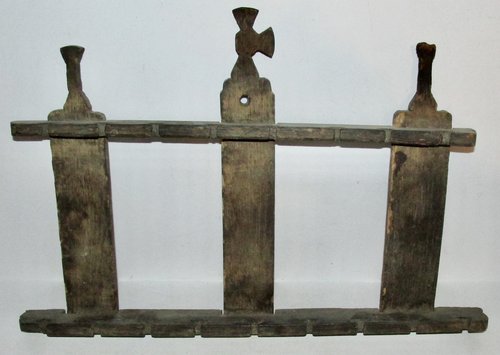
Offered is this very early American spoon rack. Origin is the Cherry Valley, NY. It is made of white oak. Originally constructed with wooden pegs that have been replaced with early nails. The top measures 17”, the bottom is 18 1/2”, and the center board is 12 1/4”. Part of cross bar is missing. Rare to find this early.
Very nice 18th century, ca.1760-1780, tombstone back and dovetailed American wall box with a dovetailed divided drawer for spices. Measurements: 12 1/2” wide x 12” tall x 8 1/4” deep. Small square nails in bottom of box and drawer. Remains of a green paint on inside of lid and very minor traces around the mitered base suggest it may have been painted at some point. It looks like the original paint was a red wash. Super nice patina.
Pilgrim period, 17th century, very rare and hard to find well turned walnut deep eating or serving bowl. Suggests PA in origin. Retains good remains of original Spanish brown paint. Footed and measures 8 1/2” x 4 1/2” tall. The best untouched very dry and well worn surface. The foot shows it was sitting on a damp surface and has minor losses but is very hard and firm. Came out of a very old and good collection. More photos available.
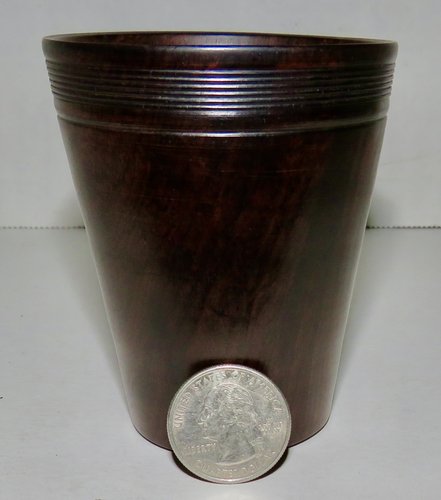
Rare pole lathe turned with incised lines around the top 18th century black walnut tavern drinking cup. 3 1/4” tall x 2 1/2” diameter top and 1 5/8” diameter base. Wonderful grain designs. A very tight and hard to see hairline crack runs about halfway down from rim.
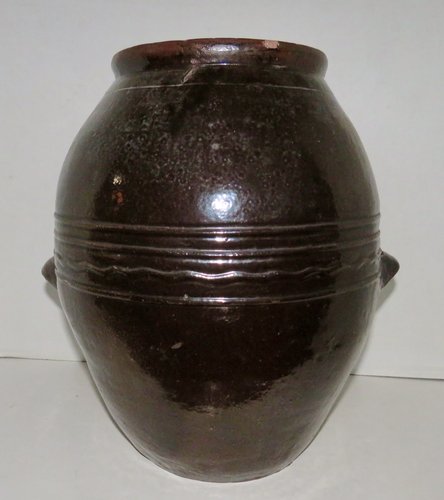
Offered is a large redware storage jar in a brown glaze. The jar has 3 raised rings around it at handle height with one ring being wavy. It has a finger brushed double stylized V design on shoulder. The jar is 13 ½” tall x 12 ½” diameter. Dating to the 19th century. Origin is unknown. The jar looks great displayed on the floor or on a low table.
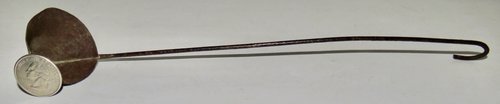
19th century long handled tin candle snuffer. Soldered seam and flattened handle. 11 1/4” o/a length with a 1 3/4” x 1 1/4” snuffer. Made for those hard to reach candleholders. No issues.
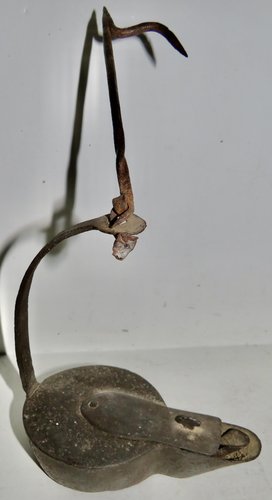
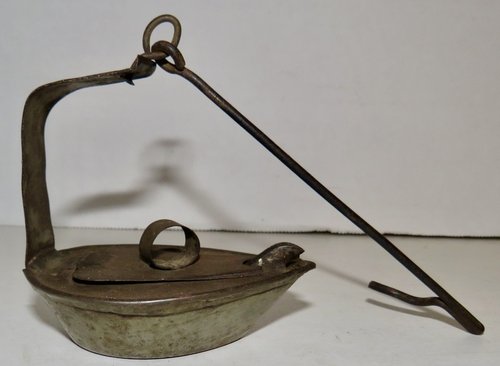
Forged iron 18th century Betty lamp with halbert hanging hook and swivel cover with a small tab finial. 8 3/4” hanging height and a 2 5/8” x 4 3/8” x 1” burner.
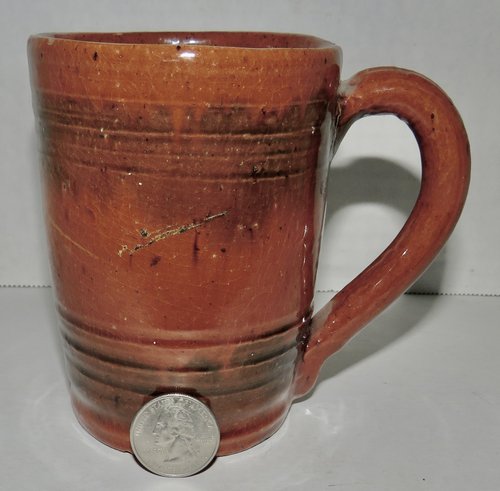
Small redware tavern mug with applied handle and incised rings with manganese slip on the bands. Super typical PA or New England color. The color is better in hand than in the photos. Measures 4 1/4” tall x 3 1/4” diameter opening. Just a tiny glaze flake on handle and a scratch.
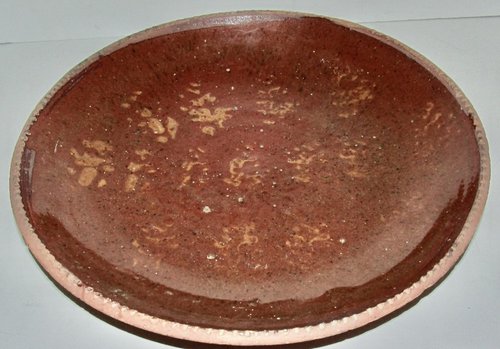
They just don't come much better than this large redware charger with yellow sponged slip. It is a huge 11 1/4” in diameter x 1 1/2” tall. A wonderfully coggled edge. There are no chips or repairs. There is a museum or collection number on back. Probably of PA origin, dating to mid-19th century.
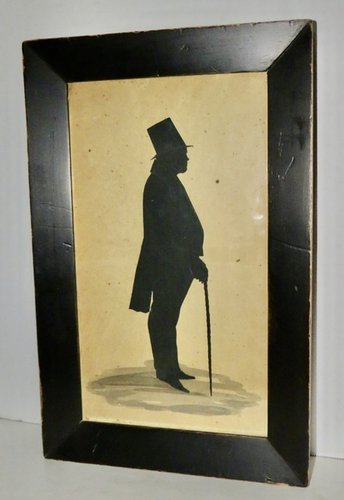
Full length profile watercolor and silhouette of gentleman with a cane and top hat. Dates to ca. 1830’s. Original black painted frame and backboard. Frame constructed with T-head nails. 14 1/2” x 9 1/2” frame and 12” x 6 1/2” sight. Rare size.
Rare 18th c. forged iron hot tody iron for heating ale and cider drinks. Would have been heated in hot coals and plunged into drink to warm. 12 3/4” o/a. Rare. Northern VA collection.
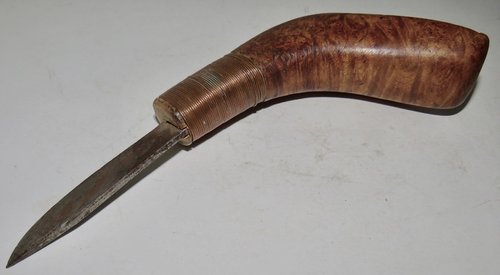
Native American ash burl crooked knife. Crooked knives were used as a tool for cutting, carving, shaving, gouging and smoothing in making wooden items and canoes. 8 1/8” o/a with a 3 1/4” blade. Handle has a flared shape rounded on the bottom to fit the hand and a curved inside top thumb groove and a slight stylized upturn at the end of the hilt.. File marks on the handle from shaping and use. Copper wire wrapping and file marking on blade. Ca.1860-1890.
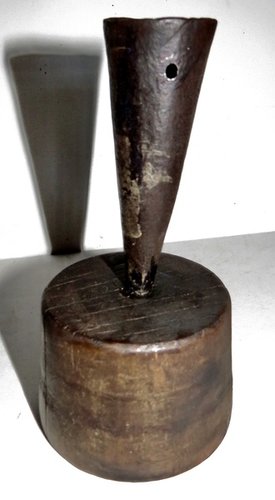
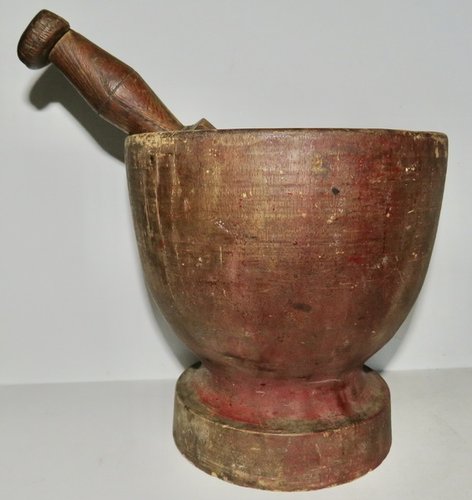
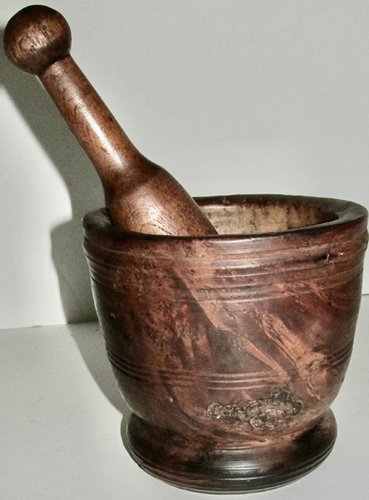
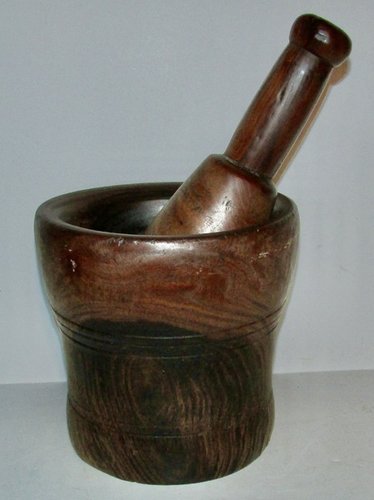
Rare American pole lathe turned mortar and pestle with carved sprue on base and the remains of the original red paint. It has a very dry surface with no cracks or damage. The mortar is 6 1/2” tall x 6 1/4” diameter top and 4 3/4” dia. base and a 7 1/2” oak pestle that has a small chip off handle knob. C.1700-1750.
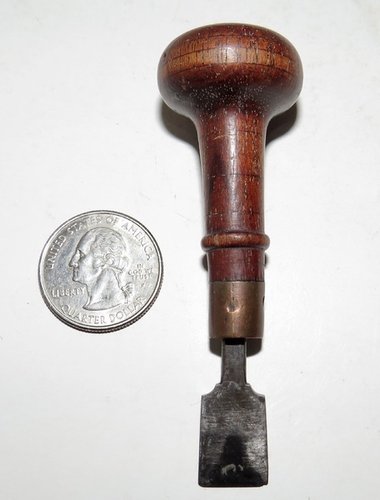
Button hole cutter having a wooden handle, forged cutter and copper ferrel. 3 1/4” with a 1/2” wide blade. The clothing item needing a button hole would be placed over a block of wood and the cutter placed where the hole was wanted and tapped with a small hammer. Similar examples are shown in “Colonial Wrought Iron the Sorber Collection”, Don Plummer, pp. 98-100.
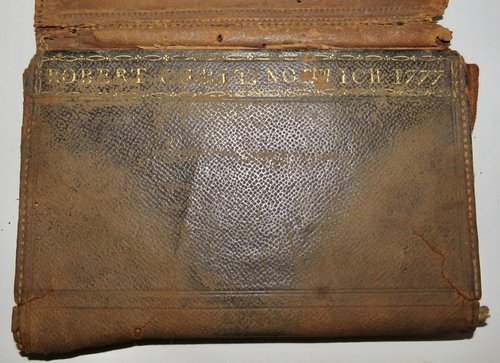
Very rare gentleman’s leather wallet. Signed, dated, and city “ROBERT CUBIT, NORWICH 1777”. It measures 7” x 5” folded. There are 3 foldout pockets inside. Center pocket has a loose cardboard note pad covered with red and white scrolled paper. Tip of leather fastening tongue is missing. Minor loss to edge of top fold and minor breaks to leather edges. Rare to find with name, city, and date.
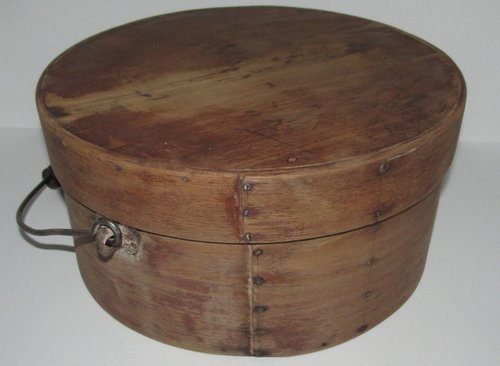
Large bale handled pantry box having very thick walls and an untouched natural surface with a great patina. Constructed using iron tacks and wooden pegs. Wire bale handle is attached via an iron escutcheons. Measurements are 11 1/2” x 5 1/2”. It has a tight age split on the bottom and good wear from use. It dates from the late 18th to early 19th century.
17th to early 18th century wrought iron double Crusie or “Phoebe” lighting device. The serrated stud supporting the upper reservoir permits adjustment as the fuel is consumed; the lower bowl collects the drip. Wonderfully twisted halbert hook with a 12” hanging height. Pans are 2” x 2 3/4” x 1” deep. No issues. Possibly English or Scottish. Nice smaller size.
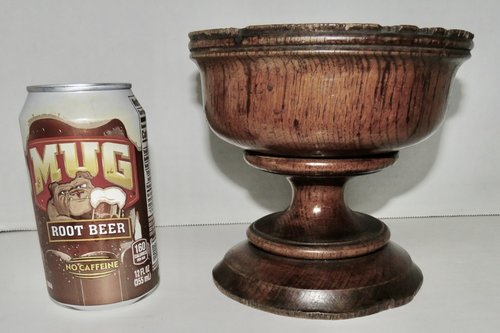
American 17th to early 18th century compote or large spice or herb bowl. Red cedar wood, possibly New England origin. 5 3/4” x 6” diameter x 5 3/4” tall with a 5” x 5 1/4” foot. Tight age cracks and minor chipping on foot edge. Very dry surface with a slight sheen from remains of original shellac. Such character and a wonderful look!
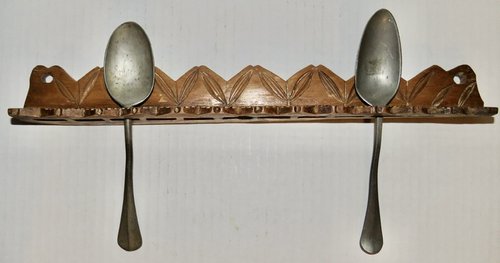
Spoon rack, walnut having original New England Spanish brown paint, chip carved with leaves and arrow heads, 12 slots for spoons, 2 hand carved hanging holes, it looks like the front part of the spoon slots may have broken and been reattached in the period. 16” long x 2” tall x 1 3/4” deep. Very dry surface, ca.1700-1740. Spoons not included.
Wonderful Pilgrim era forged iron lighting trammel, American, 20” shortest and 36” fully extended, 1/2” wide, hand cut teeth, wonderfully shaped hangers, outstanding forging work, all original, wonderful surface, 17th to early 18th century. Betty lamp is not included.
American, forged iron lighting trammel, 18th century with original surface. 24” closed and 31 1/2” extended. 5/8” wide teeth. No issues. Betty lamp is not included.
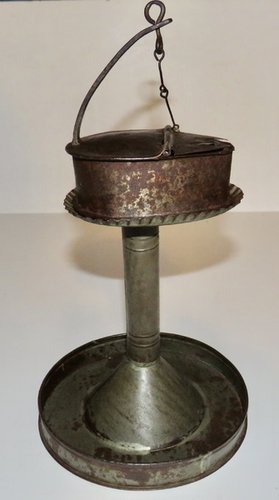
Ipswich Betty lamp stand and tin lamp, attached wick pick, heavy tin, crimped stand top with dished base, 7” tall x 6” dia. x 3/4” tall base, attributed to Ipswich region of MA., no issues, American, early 19th century. No issues.
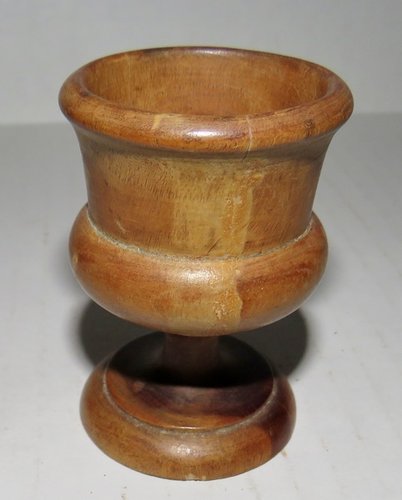
The form and grain patterns on this individual table salt or spice jar are just outstanding. It was pole lathe turned from a hard maple species. 2 1/2” tall x 1 3/4” diameter. There are no issues, 18th to early 19th century.
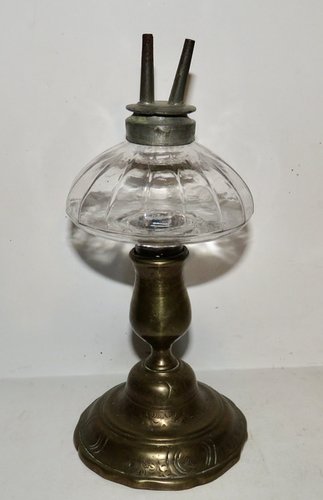
Peg lamps were made to be used in candleholders, replacing the more expensive candle with a liquid fuel burner. This peg lamp and brass candleholder are offer together for one price. The peg lamp is pressed glass with a pewter camphene double burner. The lamp has 16 flat panels and is 5” tall x 3 ½” diameter. It is in excellent condition and dates early to mid-19th century. The brass candle stick is probably French. It has very fine engraving and is 4 3/8” tall x 4” diameter base. The candleholder takes a 7/8” candle and the peg lamp fits perfectly. They look great displayed together, as on a lamp stand.
Very rare early to mid-18th century maple screw apart container, possibly to hold sponges used to apply make-up. Pole lathe turned. Good shrinkage. About 3” diameter x 3 1/2” tall. Wonderful untouched surface patina. The top has a 1 1/2” very tight shrinkage crack and a barely noticeable 1” shrinkage crack. Both have been glued at some point to keep them from expanding. Very rare. This is the only one I have ever seen.
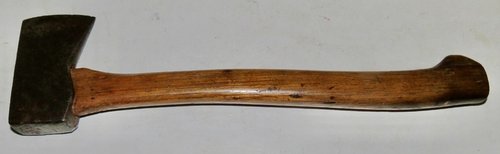
This is a not too often seen 18th century, Rev. War period, belt axe having American evolution toward the finial raised square poll and shortened blade form (typical of those from Hudson and Champlain Valley sites). Measurements are 13 1/2” o/a with a 3 3/4” x 2 1/4” axe head. Head was forged by hammering the 2 ends of a bar together to form the blade. Very nicely shaped original handle.
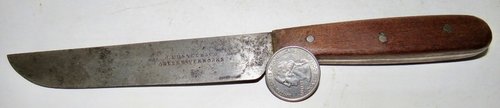
One of the best patch knives I have owned. An early J. Russell & Co. Green River Works (Established in 1834 in Green River, Mass.) patch knife. 8 3/4” o/a with a 4 7/8” blade. Wooden sides riveted on handle. Early 19th century, ca. 1840. No issues. Green River was known for producing the best steel blades in America,
18th century tack design and engraved pinwheel designs over entire surface. PA or VA origin. Great color, carved tip and wooden domed end cap with strap screw. 9” o/a. Northern VA collection.
Very rare early 18th century, ca.1720, American maple eating dish. Larger size and thin being 7 3/4” - 8” x 1/2” tall. Numerous knife marks on top side. No issues. Rare to find this early and in such good condition. Wonderful wear from use and the best patina.
Candle box, chestnut, original red wash, Square nails, unusual applied moldings, rounded end on lid, 15 x 8 3/4 x 5 1/2” tall. American, CA.1780-1820. ex. Came from the Newcomer collection in Deilhi, NY.
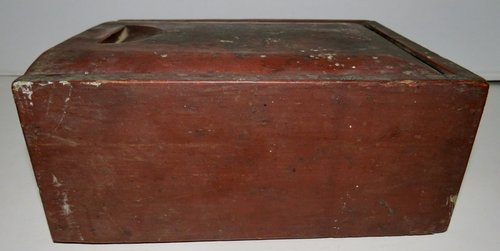
Wonderful small locking storage box having its original very dry red paint. The wood is pine and was constructed with square nails. The lock is there, no key, and there are 4 decorative tacks around key hole. Above the lock is a small brass shield with initials “WO”. Size is 12 1/8” x 3 3/4” x 2 3/4” tall. 18th c. No issues.
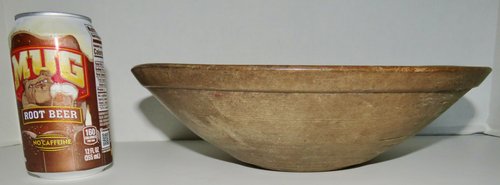
Rare 18th or early 19th century maple beehive mixing/chopping bowl. Very thinly turned with a well defined foot and 1/2” rim. Wonderful untouched natural surface. Measures 10 1/2”-11 1/4” x 3”-3 1/4”. Only flaw is a tight 1” crack in the bottom that light can be seen through. No other issues. Very smooth from use.
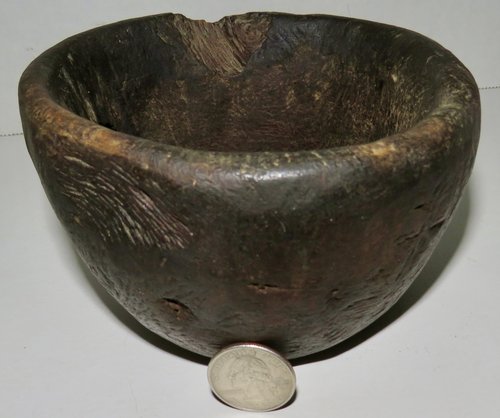
Very rare, 17th to early 18th century, Native American small white ash burl bowl. The best untouched natural surface with great wear from use. Only 4 3/4” diameter x 3” tall. Likely used as an eating bowl that gave it the very dark color and very smooth feel. It has a 3/4” x 3/4” chip out of the rim that looks like it may have been there from when it was made. These early small Native American eating bowls are very seldom found.
American pine with untouched attic dry natural surface scrub or knife board used in cleaning knifes with a “bath brick” or other abrasive that was kept in the knife board pocket. The board was placed flat on on a table, and kitchen knives and cutlery were scoured on the upper part. This one has a deep depression from lots of use. T-head and square nails date this to ca.1750. Measures 18” tall x 6 1/2” wide x 4” deep. Just minor shrinkage cracks on top.
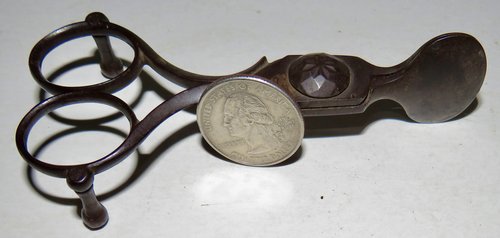
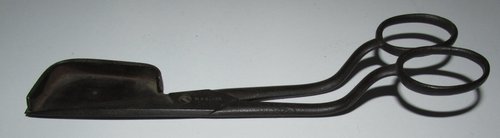
Candle wick trimmer, raised handles, 6 1/4” long, closed finger loops, fence around blade, signed H.R. Boker on flat near rivet, early to mid-18th century. Rare to be signed. Not a common style.
Early 18th century, ca.1700-1750, all iron adjustable candlestick having 3 notches for adjustment to four positions as candle burns. Rare to be all forged iron. The shaft is supported by a forged rimmed saucer base having a riveted 1/2” rim and a forged base that is rolled up onto the rim and secured with 4 tabs. There is a forged washer and nicely detailed wing nut on bottom. The wing nut sits a little below the base now so the stick rocks slightly. A very rare form.
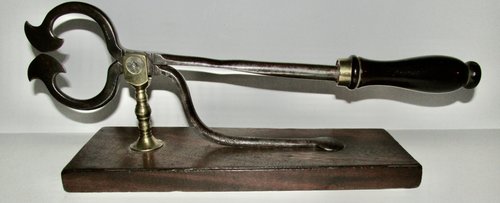
Mounted sugar nippers, signed BURTON on cutter, walnut base with fluted edge, 15 1/2” long x 4” wide, mounting nuts are hand cut iron, polished steel, lathe turned brass standard, no issues, American, early 19th century. This would have been used cut chunks of sugar from a sugar cone.
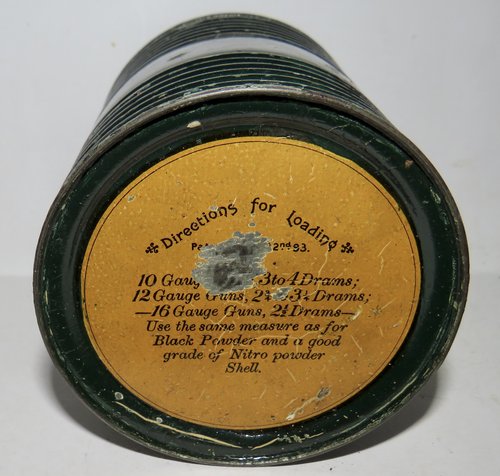
Round tin with labels on both ends. Original brass screw cap works fine. DuPont Company Delaware black powder can. The largest U.S. maker of black powder. The Brandywine River Powder Mills, 1803-1921. 3 3/4” tall x 3 1/4” diameter.
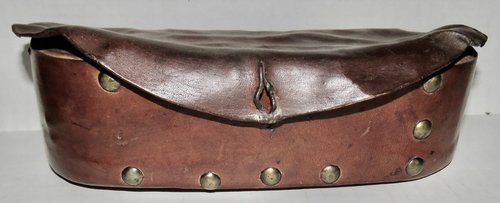
Rev. War period American brown leather (not often found color) waist covered curved cartridge box. Had a shoulder strap originally. Brass tack decoration. 9 1/2” wide x 2 1/2” deep x 2 5/8” tall. Ca.1750-1780. Leather flap is partially separated from box on back. Not often seen this nice.
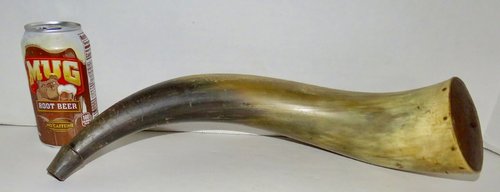
Not often seen 18th to early 19th century supply powder horn. 20” outside and 16” across ends and 3” x 3 1/2” on end. Great color with no issues. Would have been for holding supply powder on long trips. Used to fill a rifleman’s or frontiersman's powder flask. See “Powder Horns and Their Architecture” by Madison Grant, renowned expert on 18th early 19th century powder horns, for similar supply horns.
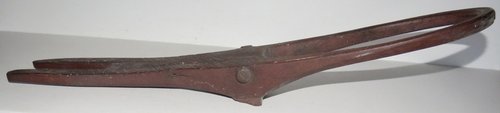
I love the form of this early wooden boot jack. It is American and it retains its original very dry oxblood red paint. There are incised chip carvings on top of the center pieces. A wonderful bent wood frame having a loop to place the boot in for removing. There is a forged iron bolt with a square nut and a forged pin holding the pieces together. Measurements are 22 x 5” wide and it dates to late 18th or early 19th century. Just a great piece of folk art.
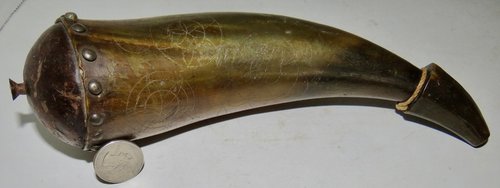
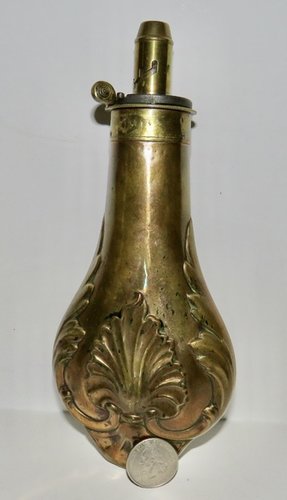
Civil War period English brass and copper powder flask with powder dispensing mechanism on the spout. Marked G & J W Hawksley Sheffield. Ca. 1850. Super embossed leaf and scroll design on both sides. Untouched surface. 8” x 3 1/2” wide.
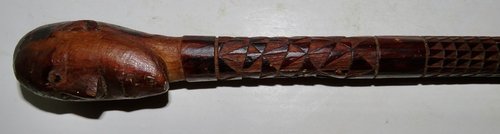
The best untouched surface folk art 19th century cane. The shaft is walnut and chip carved the entire length of the cane in varying geometric designs. Well detailed man carved onto handle having painted black hair. ca.1840-1860. 34 1/2” long x 5/8” diameter. More photos available.
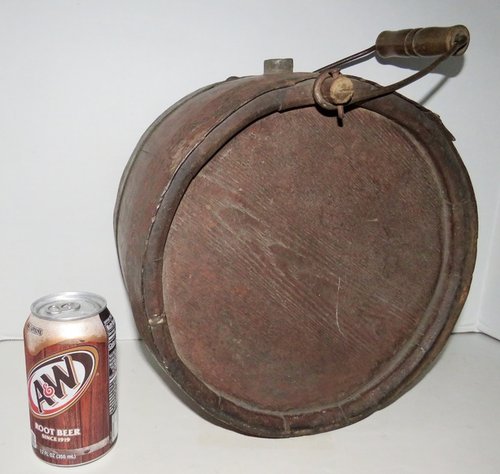
This is a very seldom seen Rev. War era, New England, c.1760-1780, staved wagon or camp canteen. Original red paint with original green on one of the two 1 3/4” iron bands secured with copper rivets. Heavy wire bale with wooden handle original wood pegs that are integral with stave. One peg has worn down and the other has an iron peg to hold the handle loop. Original pewter spout and vent hole in stave. The wood is oak. Impressed into one side “L.L. GOODRICH”. 11 3/4” diameter x 7 1/2” wide. Great condition.
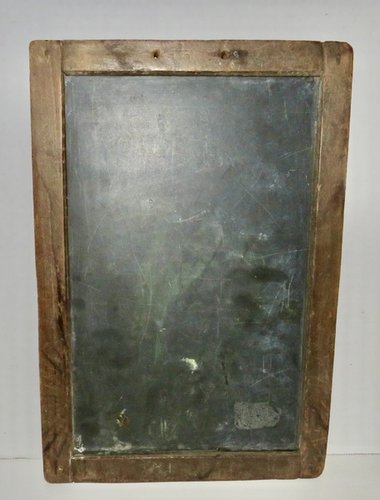
Rare 18th slate with owners name, Foster Gilbert Northfield, Mass., hand engraved in top corner of slate. Mortised corners with wooden pegs and with a rare small cutout slot for a piece of chalk on the side. 12 3/4” x 8 3/4” wide. Northern VA collection.
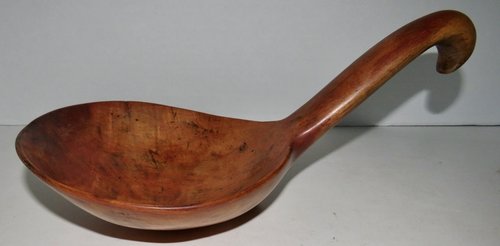
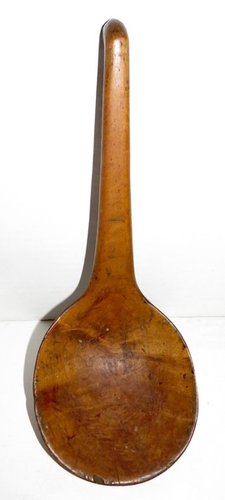
Super nice Native American large ladle or scoop with a rare foot rest on back so it could be used as a bowl. Hand carved birch wood. 7” diameter bowl, 12” across handle, early professional repair to a 3/4” x 2” triangular piece on the front edge of the bowl that is barely noticeable. 18th or early 19th century. Rare
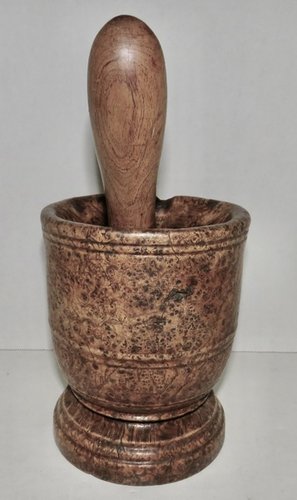
Offered is a super nice walnut burl mortar & pestle. The mortar is 6” tall x 6 3/8” diameter and the pestle is 9 1/2” long. It has very good turnings on mortar with no issues. There is a natural 2” gap on the side of the mortar. Great natural patina from use. Ca.1750-1800.
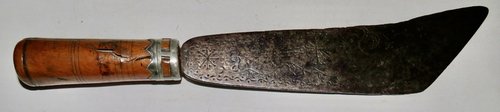
18th century French knife with engraved peacock and scrolls on one side and “BONNE FONTHENNE 1790” on the other side. In trying to translate the lettering, the most likely explanation is that it is a misspelling of "Bonne Fontaine," a French term meaning "good fountain" or "good spring”. It measures 14" o/a with a 9 3/4” blade and 4 1/4” handle. Pewter inlay on handle. Blade tang extends through handle. Shrinkage cracks in handle but solid. The engraving is outstanding.
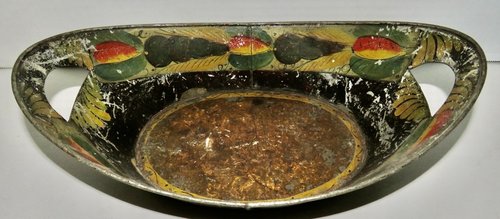
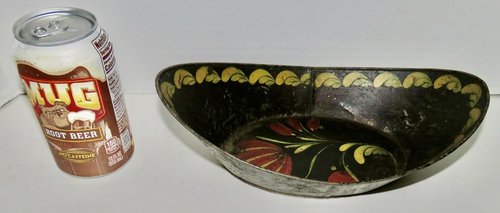
Tin tole painted apple tray. Very nice decoration around the inside and boarder of inside bottom. Colors are red, yellow, and green with gold designs on inside bottom. 12 1/2” x 7 5/8” x 2 1/4” on sides. Some minor paint scratches from use. Looks great displayed on a table or other flat surface.
Just a wonderful early storage box that oould have been used for candles. It has dovetailed construction with original snipe hinges and wire closure. It measures 14 1/2 long x 5 1/4 wide x 3 1/2” tall. It retains most of its original very dry blue paint that has mostly oxidized to a greenish color. Late 18th century. Great condition with good honest wear.
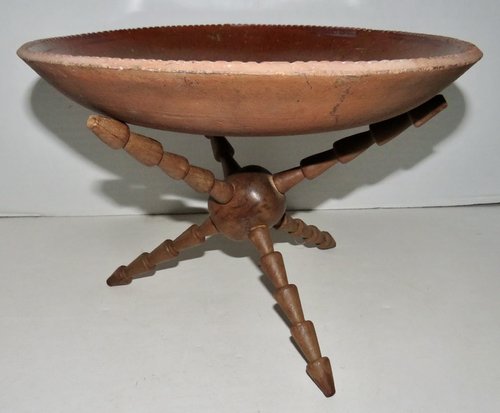
This is a not too often found plate warming stand or "cat". It is of English or American origin and made of maple wood. Measurements are 6 ¾” tall x 8” wide. Very skillfully turned legs. This stand is also called a “cat” because of the shape of the legs. No matter which 3 legs it rests on, there are always 3 legs to hold plates for warming on the hearth. C. 1760-1780. I have only owned 2 of these in my many years of collecting. Redware plate is not included but it is listed separately.
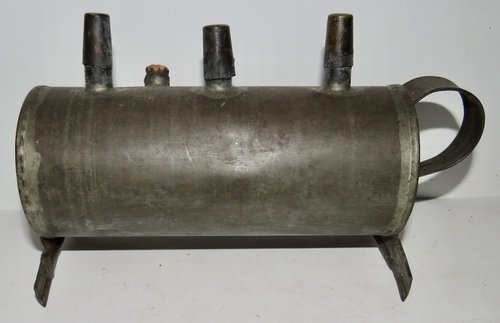
Rare three wick lamp used in the guest-room for more adequate lighting. A horizontal tin cylinder for whale oil fitted with 3 wick tubes having original caps, handle, filler tube with cork. Lamps of this type were used in guest-rooms for brighter lighting. The tin strips may have been added to the flat leg to stabilize the lamp, 8 3/4” long x 3” diameter x 5” tall at caps, untouched surface, no issues, rare to find with original caps and original cork. C. mid-19th century. See "Colonial and Early American Lighting" by Arthur H. Hayward, p. 27 for description.
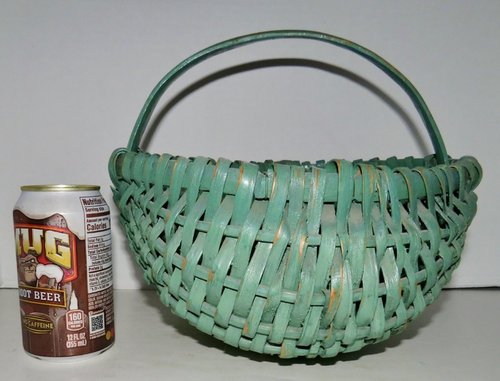
Gathering basket having the original green milk paint. 10 1/2” x 9” x 9 1/2” tall. The basket is in very good condition with just one broken weaver and a few minor scuffs from use. This basket dates late 19th to early 20th century, ca. 1890-1910. More photos are available.
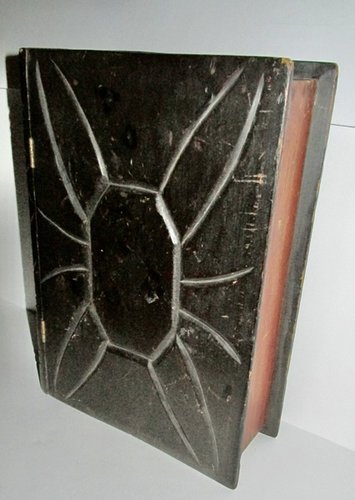
I have only owned a couple of these fake book boxes. They were made to look like a book and sit on a bookshelf but held documents instead. This book box has its original dark brown paint with fake salmon color painted pages. It has very folky deeply carved designs. The box measures 13 1/2 x 10 1/2 x 4” thick. Ca.1860-1880. Condition is good. More photos available.
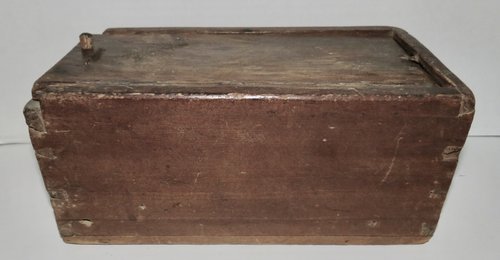
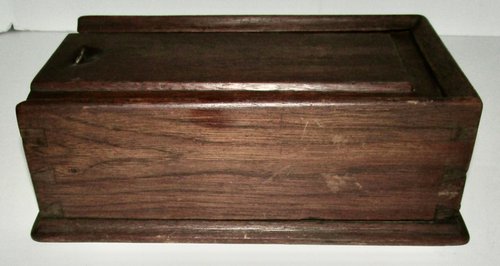
Slide lid table spice box, walnut, c.1760-1780, raised panel lid and dovetailed with T-Head nails in base, 9 3/4” x 5 3/4” x 3 1/2” tall, very tight stable crack in lid next to panel, very smoothly worn surface with wonderful patina, American, possibly of PA origin. It came out of the collection of Mark Teller in PA.
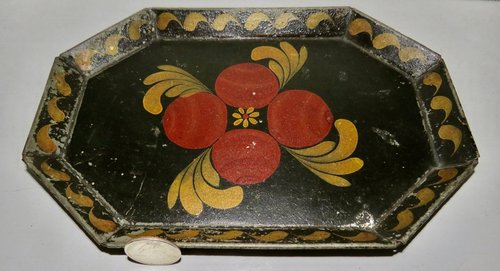
Very nice tin tole painted 8 sided coffin tray with red pomegranates and mustard color leaves. Minor paint loss on ashphaltum. 8 3/4” x 6” x 1/2” tall. Ca. 1840. Looks great displayed on a shelf.
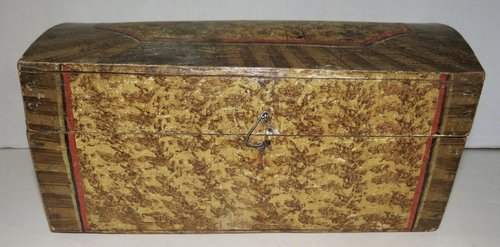
18th sponge decorated and hand painted small dome topped NH document box. Desirable mustard paint with red and black outlines. Original snipe hinges and T-head nail construction. Wire hook and loop lid fastener. 10 1/2” x 6” x 5” tall. No issues. Ca.1780-1820. This quality painting is just not seen now, especially on small boxes like this one.
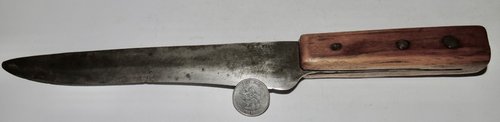
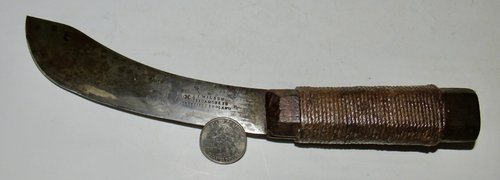
19th century shear-steel blade skinning knife. Stamped I. Wilson 37 Sycamore St. Sheffield England. This company exported knives to America in the late 18th and 19th centuries supplying frontiersmen and fur traders. The handle is 2 wooden pieces on the full tang and pinned with iron rivets and wonderfully wrapped with a cord in the Native American manner. 9 1/2” o/a with a 5 3/4” blade. No issues.
Wonderful example of a Native American canoe cup. Made by hand carving a maple burl. 8 1/4” x 3 5/8” dia. x 2” deep bowl. A piece of the original leather thong is still in the hole in handle. 18th c. Canoe cups were used by riflemen, frontiersmen, etc. for drinking water from a stream or lake. Came from a 60 year early primitives collection in upstate NY. More photos available.
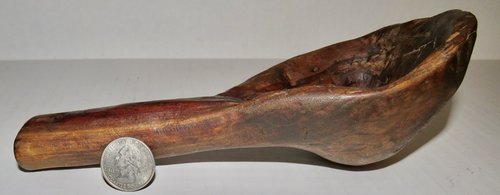
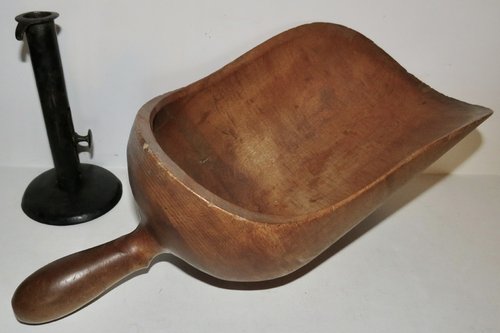
Native American scoop or ladle. Maple wood with some light tiger grain. 13 1/2” o/a length with a 5 1/2” x 6” x 1 1/2” deep bowl. Wonderful patina and very smooth from wear. Handle end is untouched with great wear and patina. Minor chipping on edge of bowl and a very tight 1/2” crack. Early 19th century.
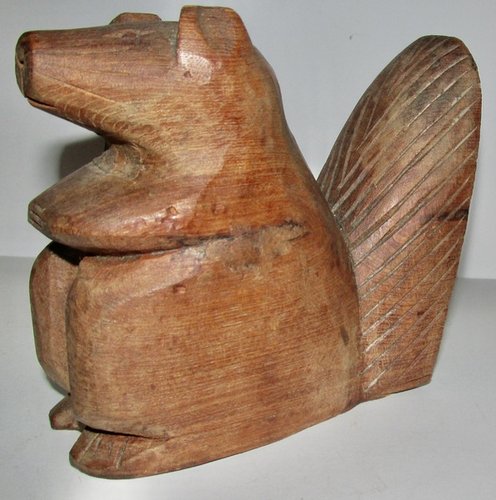
A great piece of early folk art is this wonderfully carved beaver with super details. It was carved from a single piece of walnut wood and is 4 3/4” tall x 5 1/2” long x 2 1/2” wide. Late 19th century and there are no issues.
Very scarce early 18th century mortar & pestle, both made from beautifully grained Lignum vitae wood. The mortar is 6 1/4” tall x 6 1/4” diamete and the pestle is 10” long with a 3” diameter base. There are no issues, just natural shrinkage cracks in heart wood. Good lathe turnings with fine line carvings. Early to mid 18th c.
18th century ash burl mortar & pestle. Early or original maple 9 1/4” pestle, very smooth from wear, having a very tight long shrinkage crack. Mortar has lots of eyes and untouched natural surface. There is a very tight 1” shrinkage crack, barely visible, in rim but no other issues. 6 1/4” tall x 5” diameter top and base.
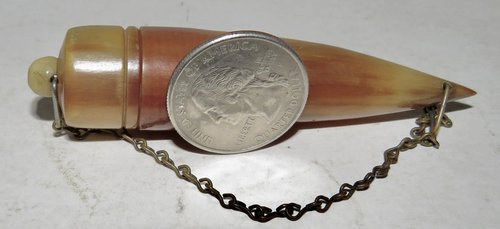
Rev. War period salt horn. 3 1/4” x 3/4”. All original with chain attached to screw cap. Would have been carried in a haversack or hunting bag and used for flavoring or preserving meat.
Early 19th century pine PA slide lid table spice box, signed “Rachel Doner” and dated “1841” on inside of cover. Original very dry red paint. Measures 7 7/8” x 6 1/4” x 3 1/4” tall at side wall. Lid has a small sliver missing on edge and is worn from use but fits well. Butt jointed with small T-head nails.
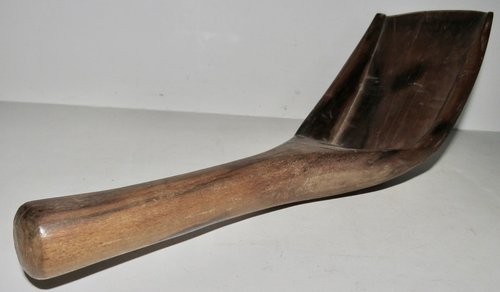
Shaker made maple scoop. The scoop is attributed to the Lebanon, OH Shaker community. This is a larger sized scoop, being 15” long. It retains its wonderful original finish and super patina. Very good condition with no issues. Ca.1880.
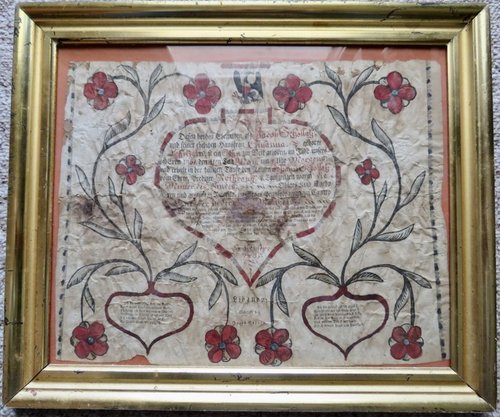
Fantastic fraktur from Lancaster county, PA. Wonderful American eagle at the top and dated 1835. Red flowers on both sides with hearts and verses at the center and bottom edges. Great colors. Period frame measures 15 1/4” x 18 1/4” and fraktur measures 15” x 12”. Drawn on hand laid paper and is on acid free paper backing. Fraktur has some minor discoloration in center heart and has rippling but no losses. Very strong piece of Pennsylvania folk art. More photos available.
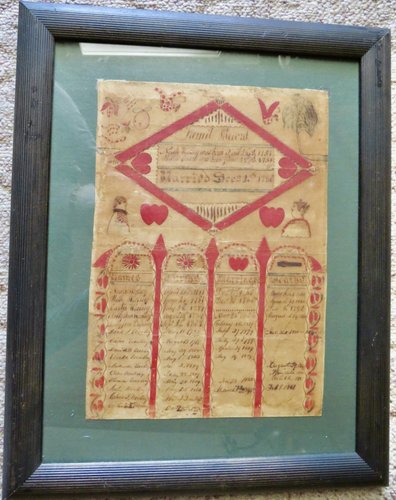
Wonderful example of a Lancaster, PA family record Fraktur. It is for the Woolsey family on the East Lancaster County PA area. It starts with Noah & Ruth Woolsey’s birth and marriage (April 1780; both born in 1751) and ends with some dependents births and deaths in the mid 1800’s. Profile drawings of Noah & Ruth with adjoining hearts. Condition is excellent with no visible abuse. There are some minor losses at the border edge. Drawn on hand laid paper of the period and is now on acid free paper backing. This fraktur was made ca.1780 and the last entry was made in Feb. 1861. There are several different handwritings, just what you want to see on these. The fraktur measures 10” x 14 1/4”. There are some colorful birds at the top and a willow tree. Guaranteed to be period and as described. Provenance included.
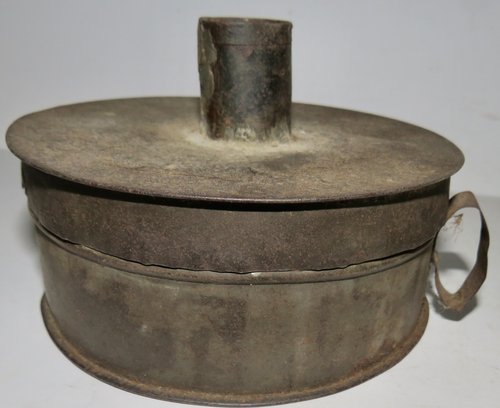
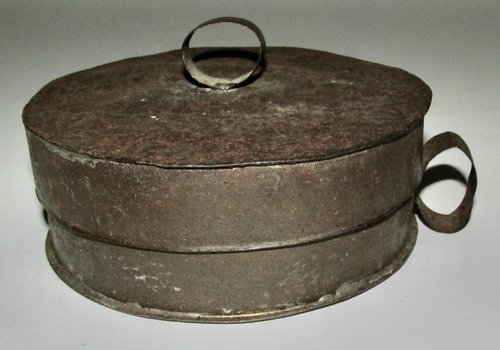
18th century tinned iron tinderbox and candle holder. The tinderbox contains an iron striker, piece of flint, piece of string for tow, and the damper to put the fire out after the candle was lit. Loop handle is soldered onto side. 4 1/4” top diameter x 3” tall. Ca.1760-1850.
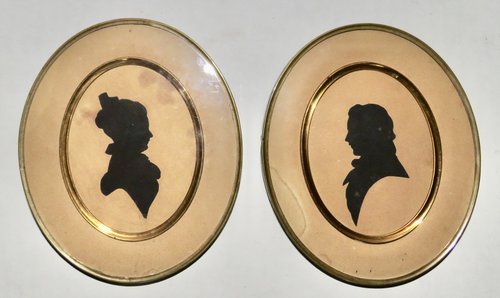
Portland, ME cut and pasted silhouettes of husband and wife, No’s 46 and 47. Provenance from The Campanelli Silhouette Collection is on back of each frame. Oval frames ar original and are 4 3/4” x 5 1/2”. Circa 1828. Water stain on outside ring of husband and a few light water stains on wife around silhouette. Rare
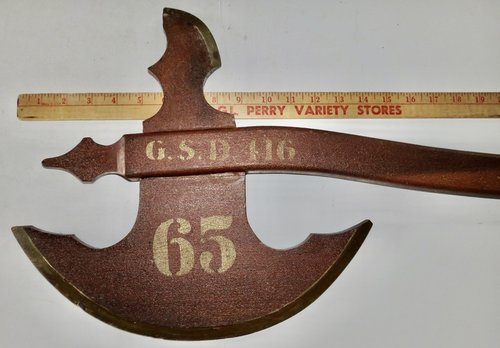
Rare double sided wooden axe with G.S.D. 416 and 65 in white paint over original crackled red paint. 42” o/a length with a 14” wide x 13” tall axe head. Handle is flat. Late 19th century and possibly of the Great Council of Indiana. Great color with no issues. Both sides are the same. Would look great displayed on a wall.
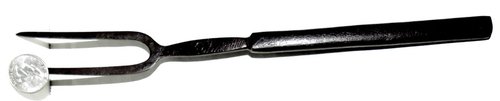
Rare whitesmithed forged iron fork with filings to shape. Late 18th to early 19th century, ca. 1780-1820. Initials M.C. on flat. 11” long. Very good smaller size.
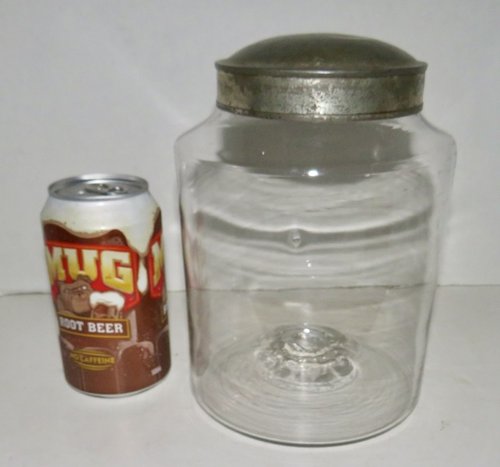
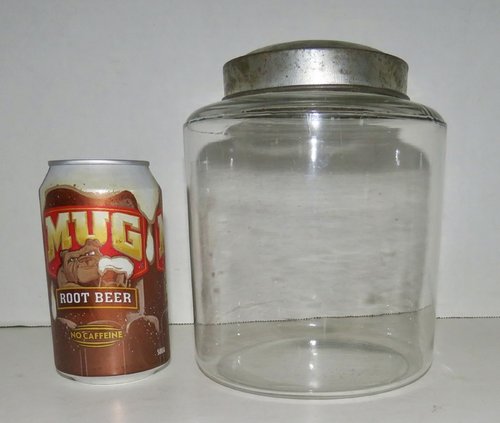
19th century, ca.1860-1880, blown glass pantry jar. Original tin lid. Pontil scar on bottom. 7 3/8” tall x 3 7/8” diameter opening and 5 1/2” diameter base. No issues. Small air bubble on side. No chips.
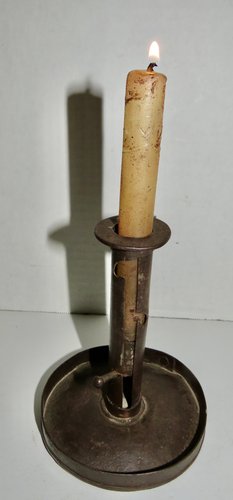
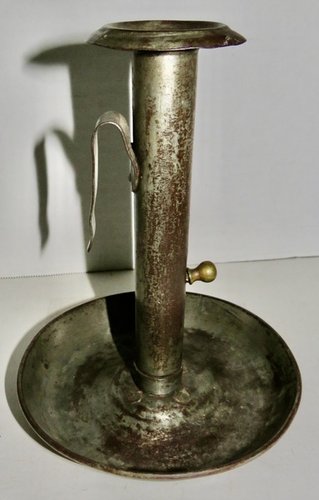
Uncommon American heavy sheet iron candlestick with a chair hook, saucer base and peened through push-up shaft. Brass knob on height adjustor. 7 3/4” tall with a 6 1/4” x 1” deep saucer base. Ca. 1780’s. No issues. Not common.
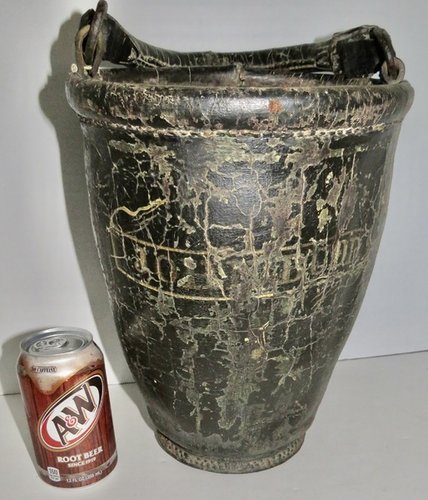
Leather fire bucket, marked inside a paint outlined banner “JOHN BUDD”. New England dating c. 1820-1830. 11 1/2” tall x 8 1/2” diameter. Original black paint has crackled and some has come off over the years showing the leather. Some bowing to the bottom from hanging many years but sits ok. Untouched and as found. No condition issues.
Super tin toleware tray having strong colors of red and ochre. On the bottom is inscribed “Presented to Ester Elling by Aunt Maxine Harlon (sp)”. 10 3/4” x 6 1/2” x 3” at ends. Ca. 1840.
19th century, ca.1880, glass pantry jar. Two piece mold with flat bottom and original tin lid. 6 3/4” x 3 7/8” opening and 5 1/2” diameter base. No chips.
Rarely seen tin Betty lamp with a hinged locking cover and forged wire hanger. New England origin, ca. 1825-1840. The form has a tapered teardrop shaped reservoir. It has a ring-shaped pull on the lid which rotates to secure the cover. Untouched natural surface. 3” L x 2 1/2” W.
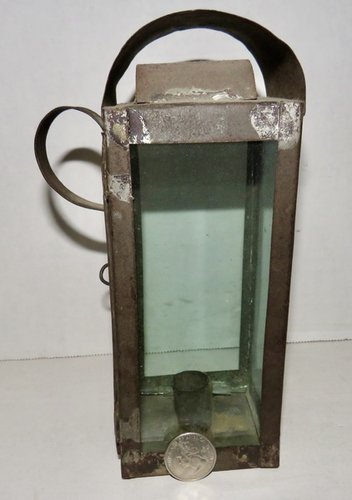
A not too often seen small size, all original, handled 18th early 19th century tin and glass lantern. Candle socket is tabbed through the bottom. Original or very early glass. The is a small chip in the top corner of one pane. Possibly a skater’s lantern. 8” tall x 2 3/4” square. Great rare example.
Wonderfully hand carved effigy Native American long scoop. Possibly butternut or maple wood. 15” long with a 3 5/8” x 5 3/8” scoop. Super patina having an untouched surface. Just how we like to find them. Early to mid-19th century. No issues.
Just a wonderful carved maple scoop of unusual form. I believe it to be Native American based on form. The scoop is a generous 13” long x 4” wide. The scoop is 5 ½” long x 4” wide. 18th/19th century. No issues. Great untouched natural surface.
Not ofter seen is this tinned sheet iron tinderbox with striker, flint, damper, finger ring lift on lid for starting fires in the 18th century. Made with fine tinsmith work, it is 4 1/2” D x 1 1/2” T. Minor surface oxidation, no issues, c.1780-1820.
Very rare hand forged and whitesmithed 18th c. American rush light having wonderful file work with decorative rings at the base and a rare decorative copper disk on top of legs, untouched surface, penny feet, 10” tall, ca.1720’s.
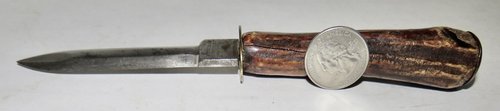
Scarce stag handled clam shucker knife. Stamped Harrison Brothers & Howson, a prominent Sheffield, England, silversmith and cutlery manufacturer, formed in 1849, and exported knives to America. 7” o/a with a 3” convex blade on one side and flat on the other side. Brass guard and iron pommel. Very shallow flat chip near pommel.
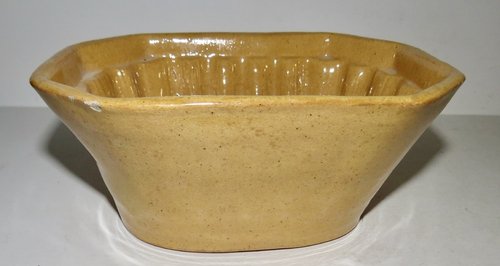
Yellow Ware Mold, clusters of grapes, 7” long x 5” wide x 3” deep, PA origin. It is in very good condition with just a few small rim nicks from use. Super rich yellow-mustard color with a design around the edge. Ca.1870-1910.
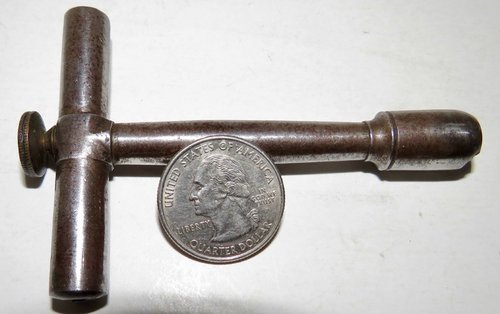
Rare forged iron rifleman’s tool having a claw swivel handle and 3 different sized screw drivers. Similar tool can be seen in “Collector’s Illustrated Encyclopedia of the American Revolution” by Neumann and karvic, p. 264. 3 1/2” with nice forging. Northern VA collection.
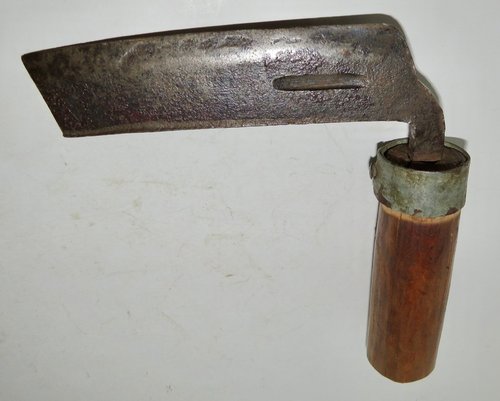
18th century forged iron basket makers froe. Used to make splint for basket weaving. Maple wood handle with forged iron ferrel fastened with a cut nail. Sprue of cutter extends through end of handle. Cutter blade edge is 5 1/4” and handle is 4 1/4” x 1 3/16”. Rare.
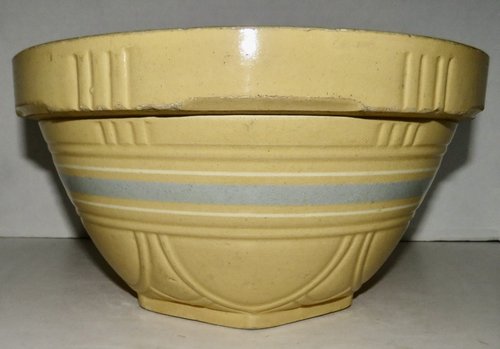
Large Yellow Ware Bowl, American, marked with an impressed, under the glaze, underlined 11 to indicate size of bowl. 11 ¾” diameter x 6 1/8” tall. Wide collar with embossed design, 1 wide blue band and 2 narrow white bands, 6-sided base. Excellent condition with age appropriate wear. Ca. 1900-1930.
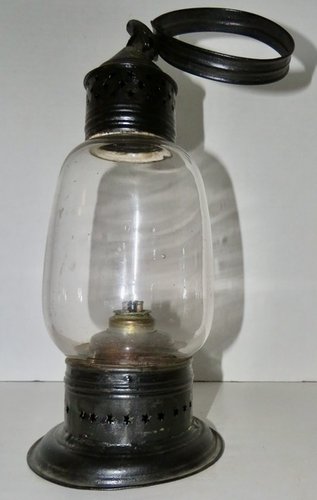
Whale oil lantern, original hand blown glass shade, removable double wick brass burner in a glass reservoir inside a tin container w/ clamps that hold it in place, 17 1/2” hanging height, 12” top of punched tin top, 4 1/2” x 7” shade, globe is sealed with original plaster top and bottom, possibly New England Glass Co., ca.1830-1855. Under a black light I can see that the black paint on the top punched area and the base has a late 19th c. black over paint. No issues. Rare this large.
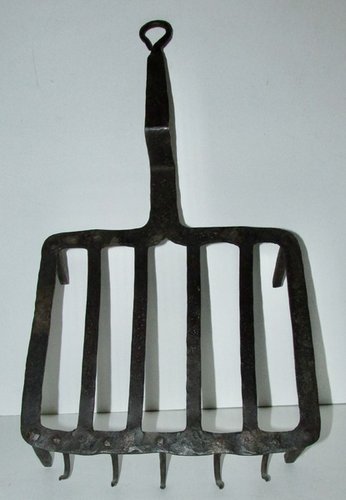
Early wrought iron broiler with step-up handle and tall feet. It has 5 hooks on front for holding chunks of meat or fish, etc. Found in New England, 18th or early 19th century, ca. 1780-1820. Measurements are 17 1/2" long x 9 1/2" x 3 1/2" high at surface. Rare form.
Rare 18th century small diameter forged iron wire lamp hook. Nice twist in the center with pigtail curls on each end. Not often seen being this small and light weight. 7 1/4” hanging length. 18th century. Betty lamp is a prop and NOT included in this sale.